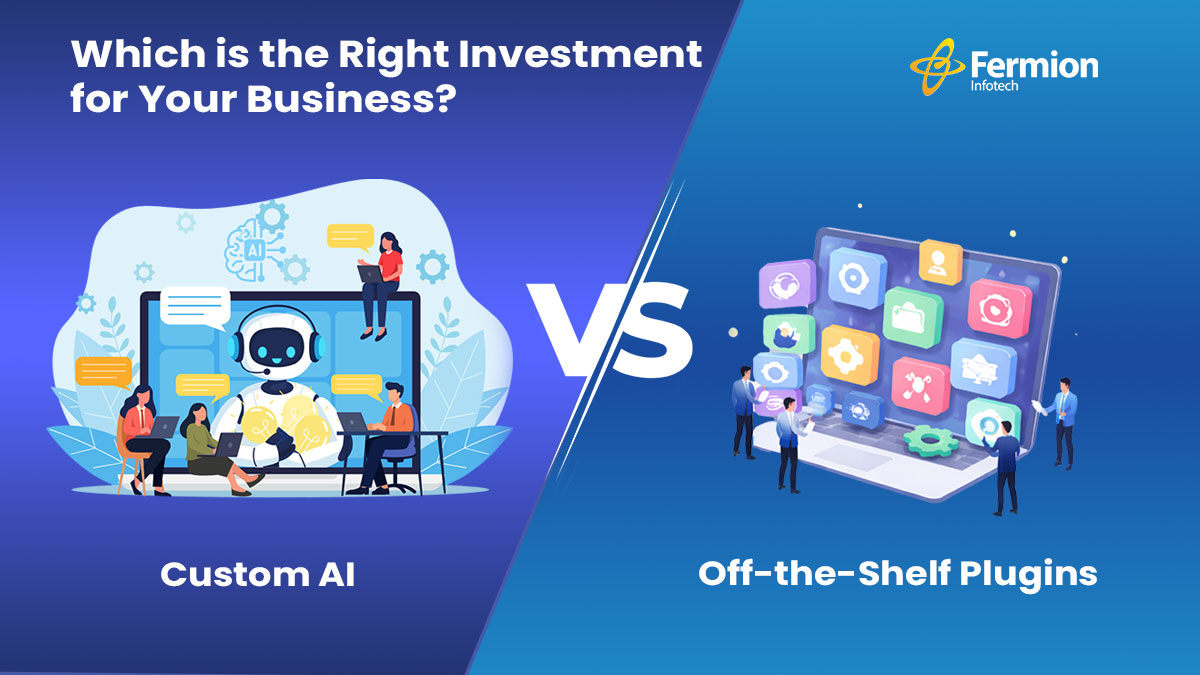
Speed or Sovereignty? That is the core of the AI debate. Choosing between an off-the-shelf plugin and a custom-built solution is a high-stakes decision that impacts your data, your budget, and your competitive edge.
Here is how to look past the hype and choose the investment that actually scales with your business.
Understanding the Two Paths: Build vs. Buy
1. Off-the-Shelf AI Plugins (The “Buy” Route)
These are pre-built tools designed for broad applicability and fast deployment.
- Examples: AI writing assistants in your CRM, chatbots in e-commerce platforms, or predictive analytics in your ERP.
- Best for: Speed, low technical overhead, and standardizing common tasks.
2. Custom AI Solutions (The “Build” Route)
These are purpose-built for your specific data, proprietary workflows, and unique business logic.
- Requirements: Investment in development, data infrastructure, and ongoing maintenance.
- Best for: Competitive differentiation and handling sensitive, proprietary data.
When Off-the-Shelf Plugins Make Sense
Plugins deliver strong ROI when your needs are well-defined and widely shared across your industry.
- Low AI Maturity: They let your organization build internal comfort with AI tools without a massive upfront investment.
- Commoditized Tasks: If you want AI-powered meeting summaries or basic customer sentiment analysis, a mature plugin solves the problem at a fraction of the cost.
- Proof of Concept: Use plugins to identify real friction points before deciding if a custom build is even warranted.
When Custom AI Justifies the Investment
Custom development is a strategic asset when your competitive advantage depends on intelligence that cannot be purchased by your competitors.
- Proprietary Data: If you have years of unique transaction history or operational patterns, a generic model cannot extract the same value that a purpose-trained system can.
- Strict Compliance: In regulated industries like finance or healthcare, sending sensitive info to third-party SaaS platforms is often a non-starter. Private-cloud AI is a necessity, not a luxury.
- Economics of Scale: At a certain volume, the cost per query for a custom system becomes significantly cheaper than paying monthly per-seat licenses for a hundred employees.
Finally, at sufficient scale, the economics shift. A custom system amortized over millions of queries often outperforms the cumulative cost of per-seat plugin licensing — especially as usage grows.
The hybrid approach: a practical middle ground
Many enterprises find success with a staged strategy: deploy off-the-shelf tools immediately to capture near-term productivity gains, while investing in custom infrastructure for the one or two use cases that are genuinely differentiating. This avoids the false choice between “build everything” and “buy everything.”
The key is identifying which workflows benefit from standardization and which require proprietary intelligence. A sales team’s email assistant probably doesn’t need to be custom-built. Your demand forecasting model, trained on five years of your own supply chain data, probably does.
Questions to ask before deciding
Before committing either way, work through these questions:
- Does the use case rely on data that only your organization has?
- Is the process you’re automating a source of competitive differentiation, or is it operational overhead?
- What is the true total cost of ownership for each option — including integration, training, and maintenance?
- Does your team have, or can it acquire, the capability to support a custom build?
- And what happens to your strategy if the plugin vendor changes pricing, discontinues the product, or is acquired?
Bottom line
Off-the-shelf plugins are excellent tools for moving quickly, reducing friction, and building AI literacy in your organization. Custom AI is a strategic asset when your data and workflows are genuinely unique. The most effective businesses use both — intentionally, and for different purposes.