
Remember when “fintech” just meant having a bank app on your phone? In 2026, those days feel like ancient history.
We’ve moved into a world where your money is getting a mind of its own. We’re seeing AI that manages your investments while you sleep and digital currencies that work instantly across every border. Finance isn’t just a side industry anymore—it’s the engine running our entire digital lives.
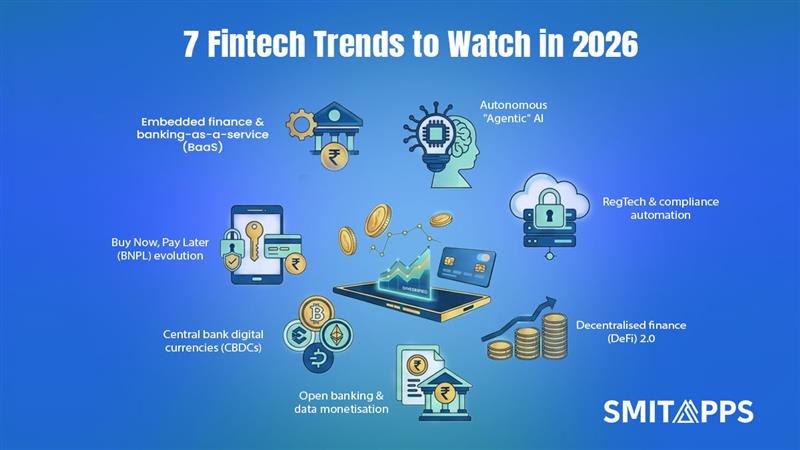
This post breaks down the seven top 7 fintech trends shaping capital markets, consumer finance, and investment strategy this year.
Trend 01
Embedded finance & banking-as-a-service (BaaS)
Embedded finance — the integration of financial services directly into non-financial platforms — is reshaping how consumers interact with money. From e-commerce checkouts offering instant credit to ride-hailing apps providing driver microloans, the lines between fintech and everyday digital experiences have blurred significantly. In 2026, embedded finance is projected to account for over $7 trillion in transaction value globally, making it one of the most investable verticals in the space.
Trend 02
Autonomous “Agentic” AI
In 2024, we had chatbots. In 2026, we have Financial Agents. We are moving away from “assisted banking” toward Autonomous Financial Intelligence. These AI agents don’t just answer questions; they execute tasks within defined boundaries—rebalancing portfolios, disputing fraudulent charges, and optimizing tax-loss harvesting without user intervention.
Trend 03
Central bank digital currencies (CBDCs)
Over 130 countries are now actively piloting or deploying central bank digital currencies, according to the Atlantic Council’s CBDC tracker. The digital euro, digital yuan, and India’s e-Rupee have moved well beyond the experimental phase, nearing full-scale issuance for investors, CBDCs represent both a disruptive risk — particularly for traditional payment processors and stablecoins — and a foundational infrastructure opportunity. Fintech companies in India building CBDC-compatible wallets, compliance tools, and cross-border settlement rails are attracting significant institutional capital in 2026.
Trend 04
Decentralised finance (DeFi) 2.0
The DeFi sector has matured considerably since its volatile early years. DeFi 2.0 in 2026 is characterised by institutional-grade protocols, improved security audits, and regulatory clarity in key markets including the EU, Singapore, and UAE. Total Value Locked (TVL) in DeFi protocols has rebounded strongly, driven by real-world asset tokenisation — including tokenised treasuries, private credit, and real estate — attracting pension funds and family offices seeking yield in a compressed rate environment. Smart contract platforms like Ethereum, Solana, and newer layer-2 networks are seeing record developer activity, signalling strong long-term fundamentals.
Trend 05
RegTech & compliance automation
As regulatory complexity intensifies globally — from DORA in the EU to evolving AML frameworks in Asia-Pacific — financial institutions are under pressure to automate compliance at scale. Regulatory technology (RegTech) startups are leveraging AI, NLP, and graph analytics to transform KYC onboarding, transaction monitoring, and regulatory reporting. The global RegTech market is forecast to surpass $28 billion by the end of 2026, growing at a CAGR exceeding 22%. For investors, this is a high-margin, recurring-revenue space with strong enterprise sales cycles and low customer churn — a rare combination in the broader fintech landscape.
Trend 06
Open banking & data monetisation
Open banking has transitioned from regulatory mandate to genuine commercial opportunity. In 2026, over 60 countries have operational open banking frameworks, with third-party providers using consumer-permissioned data to deliver superior credit scoring, financial planning, and fraud prevention. The next frontier is open finance — extending data sharing to insurance, pensions, and investment accounts. For investors, the opportunity lies in data infrastructure providers, consent management platforms, and the growing ecosystem of financial data analytics firms. Companies that help consumers and institutions unlock value from financial data are attracting premium valuations.
Trend 07
Buy Now, Pay Later (BNPL) evolution
BNPL has survived its post-2022 correction and emerged in 2026 as a more regulated, financially sustainable product category. Major players including Klarna, Affirm, and regional challengers have adapted to tighter credit regulations, improved underwriting models powered by AI, and diversified into B2B BNPL — financing for small and medium enterprises at point-of-procurement. With credit card debt at historic highs among younger demographics, BNPL continues to capture wallet share among millennials and Gen Z consumers. Investors should focus on platforms with proprietary credit data assets and diversified merchant ecosystems, rather than pure-play consumer lending models.
Final word: positioning for the fintech decade
The seven trends outlined above are not isolated developments — they are deeply interconnected. AI accelerates RegTech. Open banking fuels embedded finance. CBDCs reshape DeFi. Smart investors in 2026 are looking beyond individual companies to understand how these ecosystems interact and where durable, defensible value is being created. Whether you are allocating capital to public fintech equities, venture funds, or digital assets, understanding the structural forces driving these trends is the starting point for any credible investment thesis in financial technology.
Don’t just watch the trends—lead them. At SmitApps Technologies, we bring over 40 years of collective experience in BFSI innovation to help you stay ahead of the curve.
Contact SmitApps Technologies Today to start your next Fintech development project.