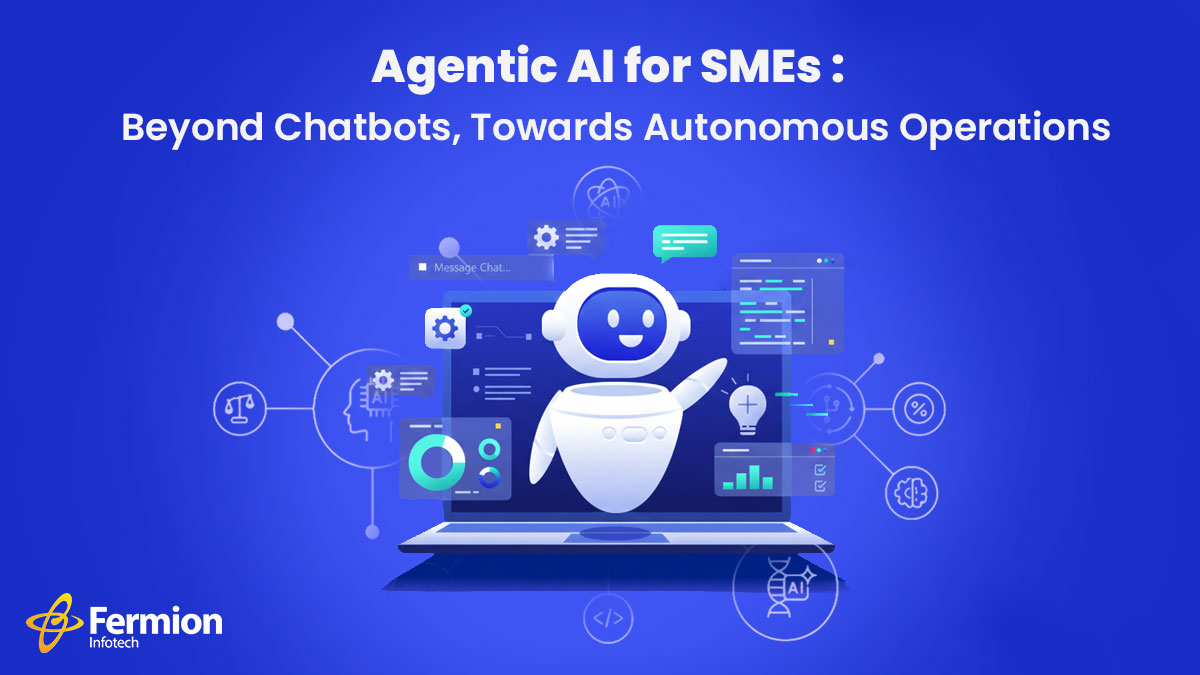
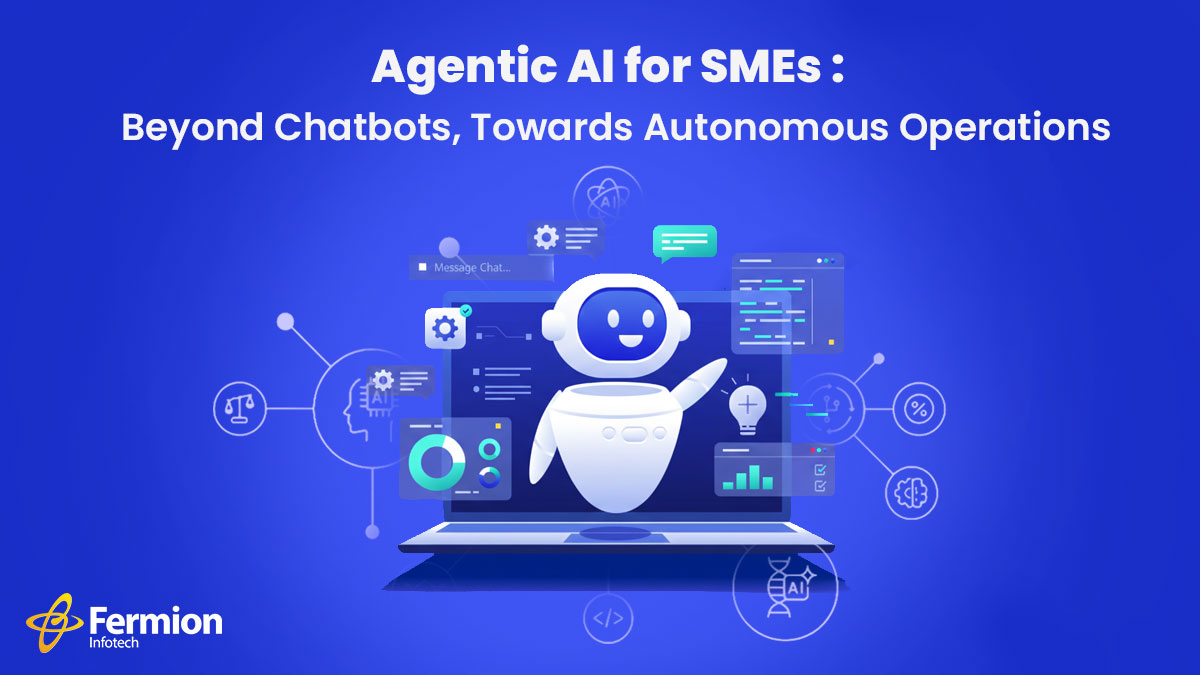
Imagine this: It’s a busy Monday morning. Instead of your customer service team sifting through refund requests or your operations manager manually checking inventory levels, intelligent AI systems are autonomously handling these tasks. They’re not just answering questions; they’re acting.
This isn’t science fiction for large enterprises anymore. This is the promise of Agentic AI for Small and Medium-sized Enterprises (SMEs), and it’s a monumental leap beyond the basic chatbots many businesses currently employ. Let’s discover how agentic AI helps SME’s work faster!
This isn’t science fiction for large enterprises anymore. This is the promise of Agentic AI for Small and Medium-sized Enterprises (SMEs), and it’s a monumental leap beyond the basic chatbots many businesses currently employ. Let’s discover how
The Chatbot Bottleneck: A Good Start, But Limited
Chatbots have undeniably brought efficiency to customer service. They can answer FAQs, guide users, and even handle simple transactions. However, their limitations quickly become apparent:
- Rule-Based Rigidity: Many chatbots follow predefined scripts. Deviate from the script, and they often get stuck, requiring human intervention.
- Lack of Context: They struggle to remember past interactions or understand nuanced situations. Each new query is often treated in isolation.
- Zero Autonomy: Chatbots are primarily reactive. They respond when prompted but can’t initiate actions, learn from outcomes, or make decisions.
- Integration Headaches: Connecting them deeply with backend systems for complex tasks can be cumbersome and expensive for SMEs.
This leads to frustrated customers and still overburdened staff. The vision of a truly autonomous digital assistant remains elusive with traditional chatbot technology.
Enter Agentic AI: The Evolution of Intelligent Automation
Agentic AI, also known as AI Agents or Autonomous Agents, represents a paradigm shift. Unlike passive chatbots, AI Agents are designed with several critical capabilities:
- Goal-Oriented: They are given a specific objective (e.g., “process this refund,” “optimize inventory for next quarter”).
- Autonomous Planning: They can break down complex goals into smaller, manageable steps.
- Memory & Learning: They remember past interactions, learn from successes and failures, and adapt their strategies over time.
- Tool Use: They can seamlessly integrate with and utilize various external systems (your ERP, CRM, payment gateways, e-commerce platform) to gather information and execute actions.
- Proactive Execution: They don’t just wait for prompts; they can monitor conditions, identify opportunities, and initiate actions.
- Self-Correction: If a step fails, they can often identify the issue, adjust their plan, and try again.
Think of it less like a talking FAQ machine and more like a highly capable, self-directed virtual employee.
Real-World Impact for SMEs: From Manual Drudgery to Autonomous Efficiency
How does this translate into tangible benefits for your business? Let’s look at two critical areas:
1. Revolutionizing Customer Service: Autonomous Refund Processing
Imagine a customer initiates a refund request. Instead of a chatbot collecting details for a human agent to review, an AI Agents can:
- Verify Eligibility: Access your order management system to confirm purchase details, return policy compliance, and payment status.
- Initiate & Track: Automatically trigger the refund process through your payment gateway or accounting software.
- Communicate Proactively: Send automated, personalized updates to the customer regarding the status of their refund, estimated processing time, and confirmation of completion.
- Flag Exceptions: Only escalate truly complex or unusual cases that require human judgment, freeing up your team for high-value interactions.
The result? Faster resolution times, higher customer satisfaction, and a significant reduction in the manual workload for your customer service team. Your AI agents become problem-solvers for the complex, not data entry clerks for the mundane.
2. Mastering Operations: Intelligent Inventory Management
For any e-commerce or retail SME, inventory is king – and often a constant headache. An AI Agent dedicated to inventory management can:
- Real-time Monitoring: Continuously track stock levels across all SKUs and locations.
- Demand Forecasting (Learned): Analyze sales data, seasonality, marketing campaigns, and even external factors (weather, holidays) to predict future demand with greater accuracy than static models.
- Automated Reordering: Generate purchase orders for suppliers when stock hits predefined (or dynamically adjusted) reorder points.
- Supplier Communication: Automatically send orders, track delivery schedules, and flag potential delays.
- Warehouse Optimization: Suggest optimal placement for incoming goods or recommend transfers between warehouses to minimize storage costs and maximize availability.
- Identify Trends: Proactively alert you to slow-moving inventory or potential stockouts for popular items.
The result? Reduced carrying costs, minimized stockouts, optimized cash flow, and more efficient use of warehouse space. Your operations team shifts from reactive firefighting to strategic planning.
Why Now? The Convergence of Power and Accessibility
The rise of Agentic AI for SMEs isn’t accidental. It’s driven by:
- Advanced LLMs: Sophisticated Large Language Models provide the “brain” for AI agents to understand context and generate natural language.
- Improved APIs & Integrations: Modern software is designed to communicate, making it easier for AI agents to connect with various platforms.
- Cloud Computing Scalability: Accessible, on-demand computing power enables even smaller businesses to leverage these complex systems.
- Specialized Development Partners: Companies like Fermion Infotech are bridging the gap, making these advanced capabilities accessible and tailored to SME needs.
Fermion Infotech: Your Partner in the Agentic AI Revolution
At Fermion Infotech, we understand the unique challenges and opportunities for SMEs in today’s digital landscape. We specialize in building robust, scalable, and intelligent solutions that move beyond off-the-shelf tools.
Our expertise in e-commerce, fintech, and AI/ML positions us perfectly to help you design and implement Agentic AI solutions that can:
- Streamline your operations.
- Enhance customer experiences.
- Drive efficiency and profitability.
Stop just “chatting” with your technology. It’s time to empower it to act.
Are you ready to explore how Agentic AI can transform your SME?
Contact Fermion Infotech today for a consultation.