
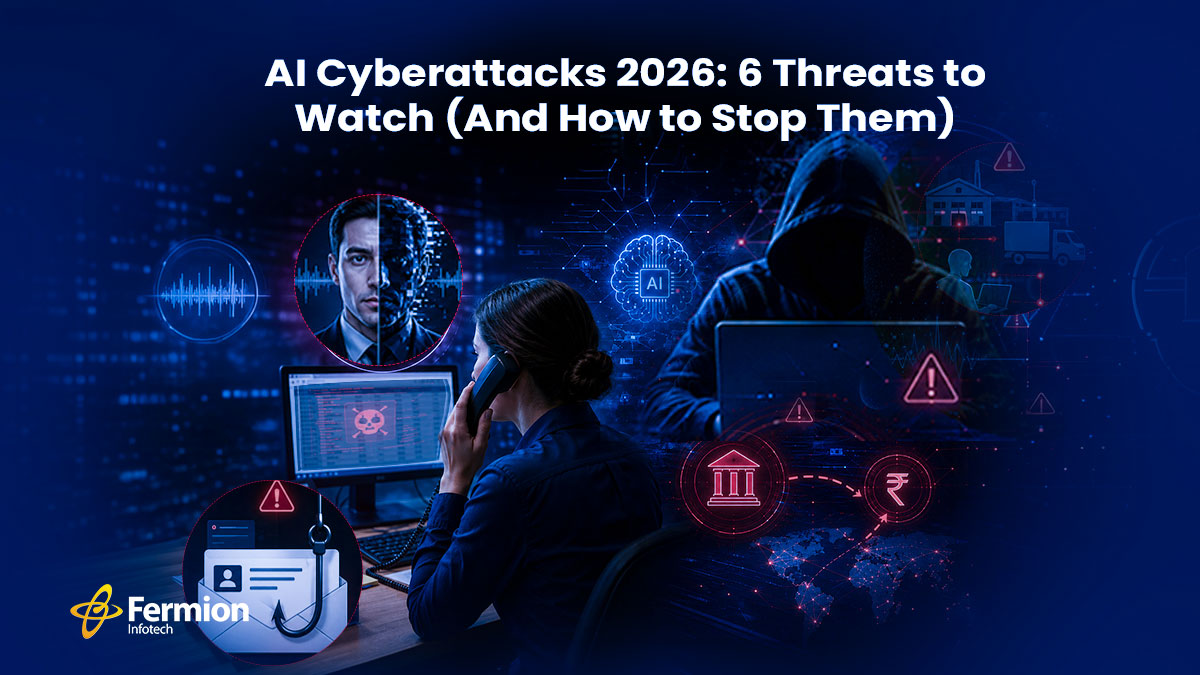
An accounts payable clerk gets a call from a “vendor” they’ve worked with for years, asking to update the bank details on file before the next invoice goes out. The voice is right. The urgency is right. The story checks out. Weeks later, the real vendor calls asking why they haven’t been paid — and everyone realizes the money went somewhere else entirely, moved by a voice that was never human to begin with.
This is modern cybercrime: AI-powered attacks are a threat every business, IT team, and everyday internet user needs to understand in 2026.
What Are AI-Powered Cyberattacks?
AI-powered cyberattacks are attacks where criminals use artificial intelligence to make their work faster, smarter, and harder to detect. This usually isn’t a brand-new category of crime. It’s an old crime, supercharged: phishing, scams, and malware, run through a system that never gets tired and never stops improving.
Industry research points to the same pattern again and again: AI is helping attackers sharpen phishing, social engineering, reconnaissance, impersonation, and automation. The real shift isn’t that AI invented new crimes — it’s that AI made the old ones faster, more scalable, and far more convincing.
In simple terms: hackers now have a tireless digital assistant. It plans the attack, writes the scam message, and adapts in real time the moment something doesn’t work.
Why 2026 Is a Turning Point for AI Cyberattacks
AI is no longer a side tool in a hacker’s kit — it’s the engine. And it’s operating in a world where cloud services, remote work, and connected apps have blown the attack surface wide open.
The numbers make the case on their own:
- 87% of organizations say AI-related vulnerabilities are growing faster than any other cyber risk, according to a recent World Economic Forum report.
- 77% of organizations report rising fraud activity over the last year — enough that cyber-enabled fraud has overtaken ransomware as the top concern for CEOs.
- 8.3 billion email-based phishing threats were detected by Microsoft in just the first quarter of 2026.
That last number is worth sitting with. Billions of attempts, in three months, aimed at ordinary inboxes.
Top AI-Powered Threats to Watch in 2026
1. Deepfake Impersonation and Fraud
This is the one that should worry you most, because it attacks trust itself. Voice cloning and video deepfakes now impersonate executives, family members, and trusted contacts convincingly enough to bypass our best instincts. In 2025, 73% of executives said they’d been personally targeted by cyber-enabled fraud — and that number is climbing. The CFO scenario above isn’t hypothetical; it’s a pattern playing across organizations right now.
2. Hyper-Personalized Phishing and Social Engineering
Forget the “Dear Customer” scam email riddled with typos. AI can scrape someone’s social media, writing style, and public data to write a message that sounds exactly like a real coworker, boss, or bank. The generic red flags people were trained to spot are disappearing.
3. Automated Attack Chains
Attacks used to unfold in stages, with a human steering each step. Now AI can run the whole lifecycle — scanning weaknesses, writing malicious scripts, adjusting tactics the moment a defense blocks the first attempt — with minimal human input. What once took a skilled team days can now take an algorithm minutes.
4. Supply Chain and Third-Party Attacks
Why attack a company directly when you can attack the vendor they trust? Research from IBM found that major supply chain and third-party breaches have quadrupled over the past five years, as attackers shift toward exploiting the web of vendors, open-source tools, and cloud integrations every business now depends on.
5. AI-Assisted Malware Development
AI tools can help write, debug, and modify malicious code, which lowers the skill floor for launching an attack. You no longer need to be an expert coder to build something dangerous — you just need the right prompts.
6. Risks From Emerging Technology
Further out, experts are tracking quantum computing’s potential to eventually undermine today’s encryption standards, along with new vulnerabilities from fast-moving “vibe coding” — AI-assisted app development that skips proper security review on its way to shipping fast.
How Serious Is This, Really?
Here’s the reassuring part: AI is a force multiplier for cybercrime, not a magic wand. It makes existing attacks faster and more convincing — it doesn’t invent unstoppable new ones. That means the fundamentals of good cybersecurity still work. They just have to be taken more seriously, and applied more consistently, than ever before.
How to Protect Yourself and Your Business from AI Cyberattacks
AI isn’t only a weapon for attackers. It’s also one of the sharpest tools defenders have. Here’s where to focus in 2026:
- Use AI-powered monitoring. Continuous, automated anomaly detection across devices, networks, cloud apps, and email catches what human eyes miss.
- Adopt behavioral analytics. Machine learning can flag subtle indicators of compromise that traditional antivirus tools overlook entirely.
- Automate incident response. Predefined playbooks paired with AI-driven alert correlation cut the time it takes to contain a threat from hours to minutes.
- Train your team — regularly, not once. Phishing and impersonation remain the top entry points. Awareness training needs to keep pace with how convincing AI-generated scams have become.
- Verify before you trust. Any urgent financial request, especially one that claims to be from an executive, gets a second-channel check — a phone call, a face-to-face confirmation — before anyone acts on it.
- Secure your AI tools. If your organization builds or uses AI applications, make sure they’re reviewed and locked down. Left unchecked, they become new front doors for attackers.
- Keep a human in the loop. Automation should help you move fast — but high-impact decisions still deserve a second set of eyes before they’re final.
Final Thoughts
That phone call at the top of this article isn’t a warning about the future. It’s already happening. Phishing emails read like they were written by someone who knows you. Scams move at the speed of automation. Attackers can now do in minutes what used to take a team days.
But the same technology powering these attacks is helping defenders catch them faster and respond smarter. The organizations that come out ahead in 2026 won’t be the ones that panic — they’ll be the ones that build verification into their habits, train their people relentlessly, and treat AI as both the threat and the tool that helps them beat it.