
Your site loads in 4 seconds. That doesn’t sound bad — until you realize you just lost roughly a quarter of your visitors before they saw a single word of your homepage.
“Speed matters” has been repeated so often it’s become elevator music — technically true, completely ignored. Most teams still file page speed under “the dev team will get to it eventually,” somewhere between rebranding the favicon and fixing that one broken footer link.
Here’s the problem with that thinking: a slow website isn’t a technical footnote. It’s a leak — quietly draining revenue, marketing spends, and customer trust, all disguised as one boring-looking metric that never makes it into the board meeting.
Let’s break down what page speed and Core Web Vitals actually are, why they matter far more than most companies realize, and what a slow site is quietly costing you.
What Are Core Web Vitals, Actually?
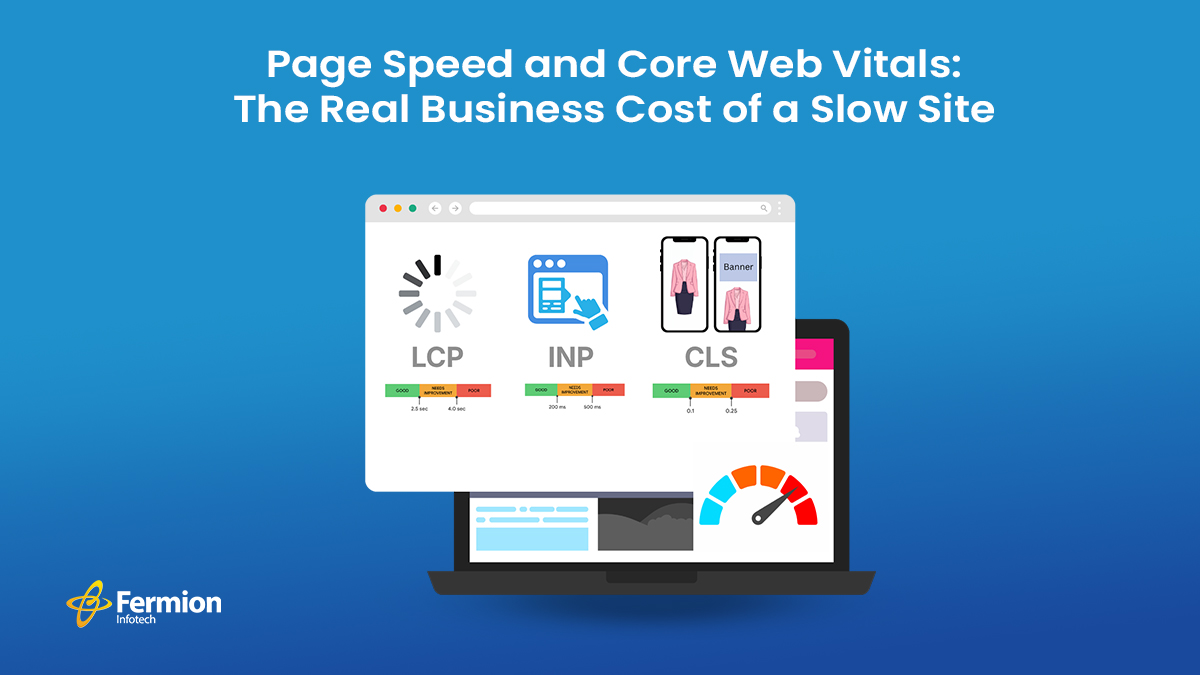
Core Web Vitals are a set of metrics Google uses to measure real-world user experience on a webpage. There are three that matter most:
Largest Contentful Paint (LCP) — How long it takes for the main content of a page (usually a hero image, headline, or key visual) to load. Google considers anything under 2.5 seconds “good.”
Interaction to Next Paint (INP) — How responsive your site feels when someone actually clicks, taps, or types. This replaced First Input Delay in 2024 and measures the full lifecycle of an interaction, not just the first one. Under 200 milliseconds is the target.
Cumulative Layout Shift (CLS) — How much your page visually jumps around while loading. Ever tried to tap a button and had an ad load in at the last second, causing you to misclick? That’s a CLS failure. Under 0.1 is considered good.
These aren’t arbitrary numbers Google invented for fun. They’re built from research on how real users perceive speed, frustration, and trust — and they directly correlate with whether someone stays on your site or bounces.
The Business Cost Nobody’s Tracking
Here’s the part that should get a CFO’s attention: page speed problems show up on the balance sheet, they just don’t get labeled that way.
Conversion rate drops fast. Research from Google and various e-commerce studies consistently shows conversion rate decay as load time increases — often in the range of a 20% drop as page load time goes from 1 to 3 seconds, with steeper drops beyond that. If your checkout flow has a sluggish INP score, people abandon carts not because they changed their mind, but because the button felt broken.
SEO rankings take a hit. Core Web Vitals are a confirmed Google ranking signal. Two sites with similar content and backlink profiles can rank differently based purely on experience metrics. If competitors are faster, they get the click — and the compounding organic traffic that comes with it.
Paid ad spend gets wasted. If you’re running Google Ads or Meta campaigns, a slow landing page means you’re paying full price per click and then losing a chunk of those visitors before the page even finishes loading. Slow pages also hurt Quality Score, which raises your cost-per-click. You’re paying more to convert less.
Brand trust erodes quietly. Users don’t consciously think “this site has a 4.2 second LCP.” They think “this feels cheap” or “this feels broken,” and they leave. That perception transfers to how they judge your product or service, even if the two have nothing to do with each other.
Mobile users suffer most. Over half of global web traffic is mobile, often on inconsistent networks. A site that feels fine on a developer’s fiber connection can be nearly unusable on a mid-range phone with spotty 4G. That gap is where a huge percentage of lost conversions live.
Why This Gets Overlooked
Speed problems are easy to ignore because they’re invisible in most reporting dashboards. Traffic numbers look fine. Ad spend looks normal. But bounce rate, cart abandonment, and “visitors who never made it past the homepage” quietly absorb the damage. Nobody connects a 30% higher bounce rate on mobile to a 1.2 CLS score, because most marketing and business teams have never been shown the connection.
This is also why speed tends to degrade over time even on well-built sites. A marketing team adds a chat widget. Then a personalization script. Then three more tracking pixels and an A/B testing tool. Each addition seems harmless individually, but together they slowly strangle load time — a phenomenon developers call “JavaScript bloat” or “death by a thousand scripts.”
What Actually Moves the Needle
Fixing page speed isn’t about chasing a perfect Lighthouse score for its own sake. It’s about targeted engineering work that removes real friction for real users:
- Image and media optimization — modern formats (WebP/AVIF), proper sizing, and lazy loading for anything below the fold
- Reducing and deferring JavaScript — auditing third-party scripts and only loading what’s actually needed, when it’s needed
- Server response time (TTFB) — better hosting, caching layers, and CDN configuration so the very first byte arrives faster
- Reserving layout space — explicit dimensions for images, ads, and embeds so nothing shifts once it loads
- Code splitting and critical CSS — loading only what’s needed to render the visible screen first, deferring the rest
- Font loading strategy — avoiding render-blocking web fonts that delay text from appearing
None of these are one-time fixes. Speed is a maintenance discipline, not a project with an end date — which is exactly why it needs to be baked into how a site or app is built from day one, not bolted on afterward.
Speed Is a Design Decision, Not Just a Dev Task
The teams that get this right treat performance as a product requirement alongside design and functionality — not a QA checklist item at the end. That means:
- Setting performance budgets before development starts (e.g., “homepage LCP must stay under 2 seconds”)
- Reviewing the impact of every new feature, script, or integration on load time before shipping
- Testing on real mid-tier devices and throttled networks, not just fast office Wi-Fi
- Monitoring Core Web Vitals continuously in production, not just during a pre-launch audit
This is also where the build approach matters. A site or app architected with performance in mind from the start — smart component structure, minimal dependency bloat, proper caching strategy — will always outperform one where speed is retrofitted after the fact.
The Bottom Line
A slow site is not just a minor inconvenience — it’s a leak in the funnel that touches SEO, ad performance, conversion rate, and brand perception all at once. And because the damage is spread across so many metrics, it rarely gets the attention it deserves until a competitor faster site starts winning the customers you should have kept.
If your site or app hasn’t had a real performance audit recently, that’s usually the fastest, highest-leverage place to start — often surfacing bigger wins than a redesign or a new marketing campaign would.