
For decades, banks have assessed property collateral primarily through a familiar set of parameters—ownership, title, valuation, location, marketability, legal enforceability and insurance.
But the risk environment surrounding physical assets is changing.
A property may have a strong market value today, but its long-term value, marketability, insurability and resilience could increasingly be influenced by environmental and climate-related factors.
Consider a few questions:
- Is the property exposed to flooding?
- Is it located in an area vulnerable to cyclones, earthquakes, wildfires or rising sea levels?
- How energy-efficient is the building?
- Does it have a recognised green-building certification?
- Could environmental litigation or regulatory non-compliance affect its value?
- Is adequate insurance available against material climate events?
These questions suggest that collateral management may need to evolve beyond maintaining a static financial and legal description of an asset.
Building a Sustainability Profile of Your Collateral
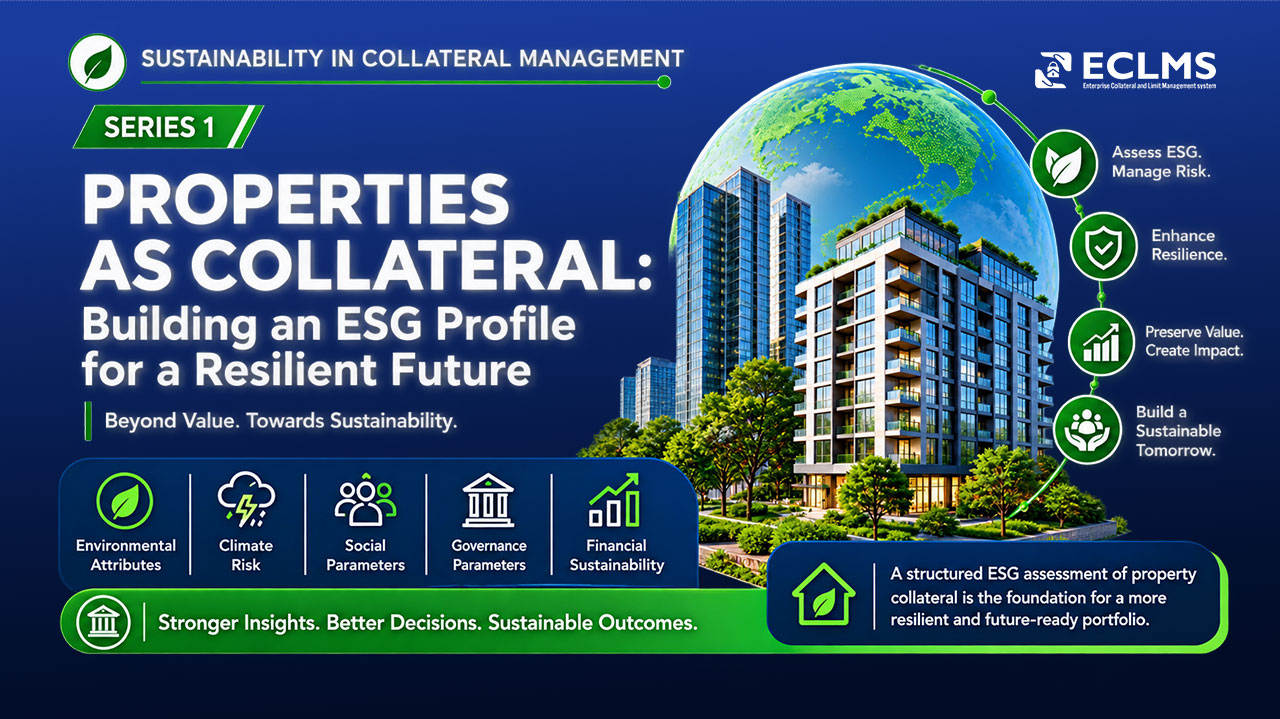
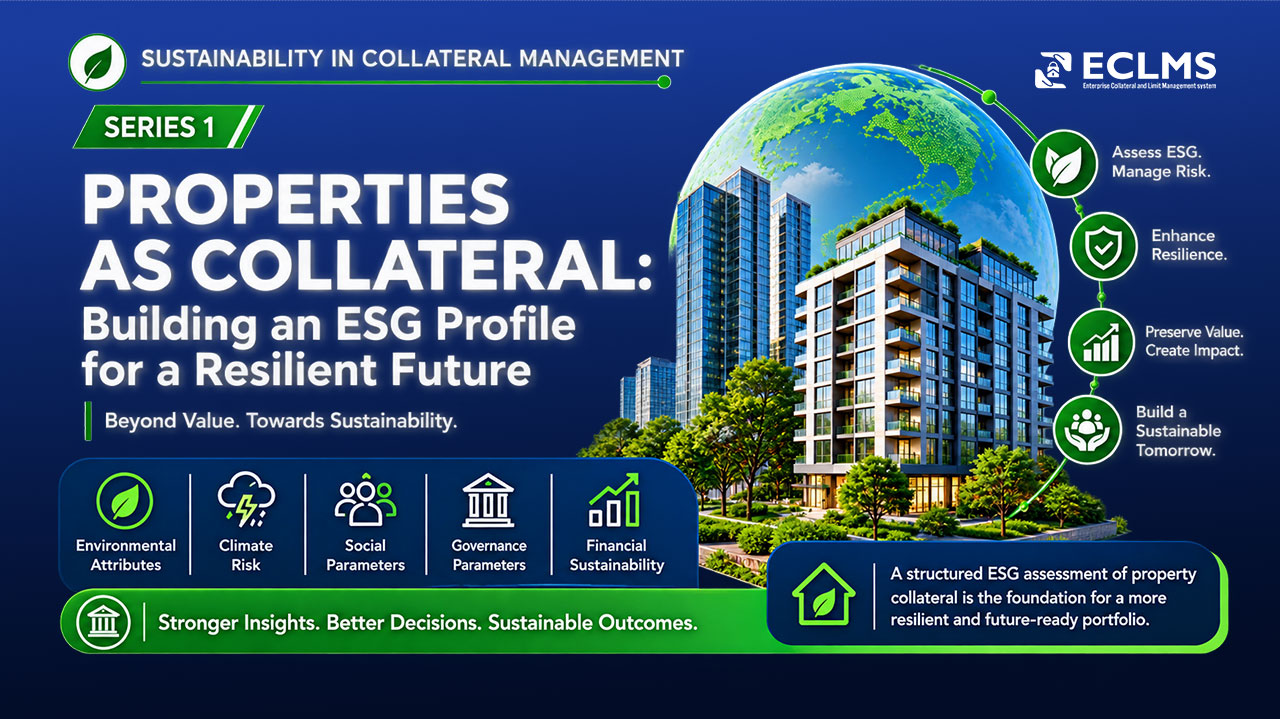
For properties and physical assets, we believe a structured ESG assessment should consider data across five broad dimensions:
- Environmental Attributes
- Climate Risk
- Social Parameters
- Governance Parameters
- Financial Sustainability
The accompanying infographic provides an illustrative framework of the data points that banks may consider capturing under these dimensions.
A structured sustainability dataset can potentially help banks develop capabilities for:
- Climate vulnerability assessment
- ESG risk profiling
- Green asset identification
- Sustainability-linked financing assessment
- Climate insurance monitoring
- Portfolio-level sustainability analytics
- Identification of collateral exposed to emerging environmental and climate risks
Borrower ESG Risk and Collateral Sustainability Risk Are Not the Same
An important distinction needs to be made between Borrower ESG Risk and Collateral Sustainability Risk.
A borrower may have a strong corporate ESG profile, while a particular property offered as collateral may still be located in a high flood-risk zone, have poor energy efficiency or face other environmental vulnerabilities.
Conversely, an individual asset may have strong sustainability characteristics even when the broader ESG profile of the borrower requires improvement.
Therefore, the sustainability profile of collateral deserves to be assessed as a distinct—but interconnected—dimension of enterprise risk and collateral management.
The Question for Banks Is Changing
As banks progressively strengthen their ESG and climate-risk frameworks, the question may no longer be only:
“What is the current value of my collateral?”
It may increasingly become:
“How sustainable and climate-resilient is my collateral—and what could that mean for its value over the life of the exposure?”
This is the first article in my series on Sustainability in Collateral Management.
In the next article, we will discuss the significantly more complex challenge of ESG assessment of manufacturing and industrial assets, including how a common manufacturing ESG dataset can be supplemented with industry-specific sustainability parameters.
#CollateralManagement #ESG #Sustainability #ClimateRisk #Banking #RiskManagement #GreenFinance #SustainableFinance