
Every bank operates on trust — and that trust is only as strong as its ability to know, at any given moment, how much exposure it carries across counterparties, products, and geographies. Yet many financial institutions, credit and exposure limits are managed in isolation: a treasury system here, a core banking platform there, and a patchwork of spreadsheets holding it all together.
This fragmentation is no longer a nuisance. It is a risk.
- 67% of banks report limit data is siloed across 3+ systems
- 4–8 hr saverage delay in breach detection with end-of-day monitoring
- 3× higher operational cost when limits are managed manually
Why integration is the executive priority, not the IT priority
It is tempting to frame system integration as a technology project — something delegated and revisited at a quarterly review. But the consequences of fragmented limit management surface directly on the balance sheet, in regulatory examinations, and in the boardroom after a breach.
When your core banking system processes a transaction without querying live limit data from your treasury system, you are not running two separate platforms. You are flying blind on one of your most critical risk controls.
“Real-time limit visibility is not a nice-to-have feature. It is the difference between catching an exposure breach in seconds and discovering it in the morning report.”
The three integration failure points executives must know
1. Data latency
Most legacy architectures rely on batch processing — limits are reconciled at end-of-day or even end-of-week. In fast-moving markets, a counterparty’s exposure can breach limits multiple times within a single trading session before anyone is notified. By the time the report lands, the damage is done.
2. Siloed approval workflows
When limit changes require sign-off across treasury, credit, and operations, but each team works from a different system with no shared record, approvals slow to a crawl. More dangerously, temporary overrides granted in one system may never be registered in another — creating phantom headroom that doesn’t exist.
3. Incomplete counterparty view
A counterparty that appears within limits in the core banking system may have significant exposure sitting in the derivatives book, the trade finance module, or an off-balance-sheet facility. Without a consolidated view, no single number tells the truth about total exposure.
What genuine integration looks like
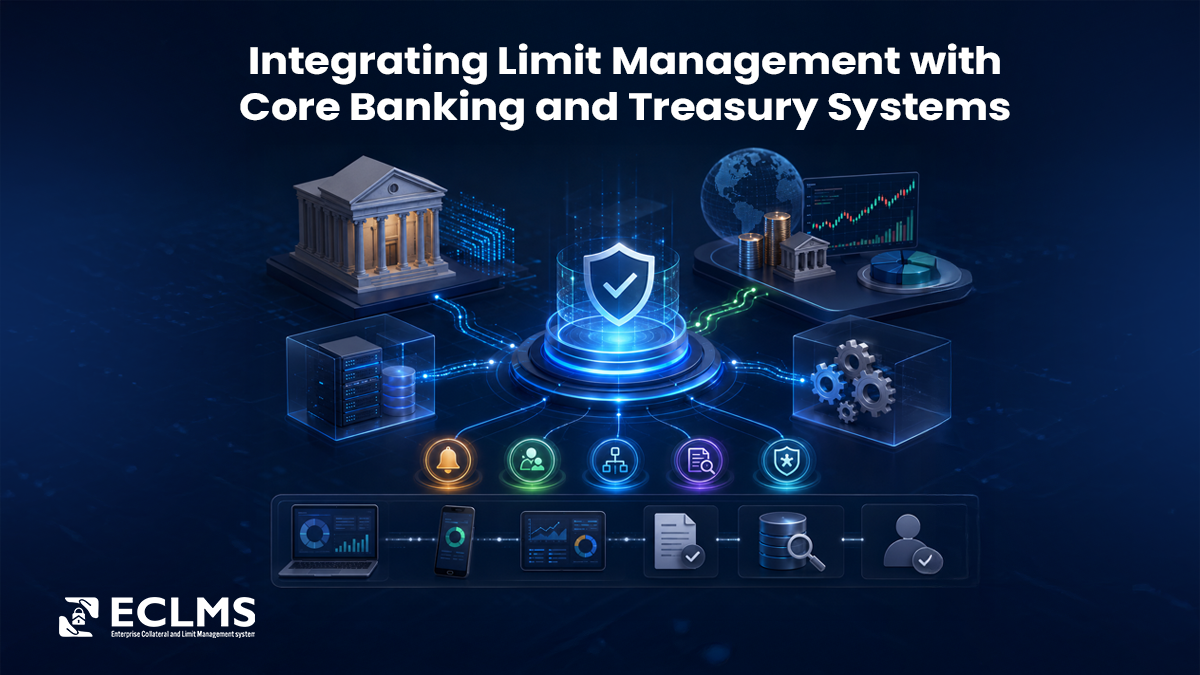
A modern, integrated limit management architecture connects real-time transaction data from core banking, live market positions from treasury, and limit governance workflows into a single, authoritative control layer. Changes to limits propagate instantly. Breaches trigger alerts before — not after — settlement. And every decision leaves an auditable trail across systems.
The capabilities that matter most at the executive level:
- Real-time limit utilisation visible across all business lines simultaneously.
- Automated breach alerts routed to the right approver without manual escalation.
- A single limit hierarchy that core banking and treasury systems query from one source of truth.
- Full audit log of limit changes, exceptions, and approvals — regulator-ready at any point.
- API-based connectivity that integrates without replacing existing core systems.
Enterprise Credit Limit Management System (ECLMS)
ECLMS is purpose-built for financial institutions that need unified limit management system without ripping out their existing infrastructure. It connects via secure APIs to your core banking platform and treasury systems, delivering a real-time, consolidated limit control layer — with configurable workflows, breach escalation, and regulatory reporting built in from day one.
Banks using ECLMS have reduced limit breach response time from hours to minutes, eliminated manual reconciliation between systems, and walked into regulatory audits with complete, timestamped audit trails — without any last-minute scramble.
Build, buy, or integrate?
Most institutions do not need to replace their core banking system to solve this problem. What they need is a dedicated limit management layer that acts as the single source of truth — connecting upward to the board dashboard and downward to every system that touches a limit-sensitive transaction.
The right question is not “can our current systems be patched to do this?” — most can, to a degree. The right question is: “can we afford the next breach, the next regulatory finding, or the next quarter of manual reconciliation while we wait for a patch?”
Integration is achievable in weeks, not years, when the architecture is designed for it from the start.
Final Words
The institutions winning on risk management in 2026 are not those with the most sophisticated models. They are the ones where the right limit data reaches the right person in real time — automatically, reliably, and with full accountability. Integration is what makes that possible.
If your limit management still depends on overnight batch runs, manual overrides, or spreadsheet reconciliations between systems, this is not a technology debt issue. It is a strategic risk issue — and it belongs to the agenda today.