
Vehicles as Collateral: What ESG Information Should Banks Capture?
Vehicle finance represents one of the most widespread forms of secured lending—from personal cars and two-wheelers to commercial fleets, buses, trucks and specialised industrial vehicles.
Traditionally, banks assess vehicle collateral through parameters such as make, model, age, registration, ownership, insurance, market value and depreciation.
These remain fundamental. But as sustainability considerations become increasingly relevant to financial institutions, another question emerges:
Should banks also understand the sustainability characteristics of the vehicles they finance and hold as collateral?
In our opinion, increasingly yes—but the assessment needs to remain practical, proportionate and relevant to lending and collateral risk.
Vehicle ESG Assessment Is More Than EV vs ICE
The first sustainability distinction that comes to mind is usually:
Electric Vehicle or Internal Combustion Engine Vehicle?
That is important, but it is only the starting point.
Two diesel commercial vehicles of similar age and value may have very different emission standards, fuel efficiency, utilisation patterns and remaining economic lives.
Similarly, two electric vehicles may differ significantly in battery technology, battery health, remaining warranty, charging compatibility and expected residual value.
For a banker, the sustainability framework should therefore focus on information that could influence the vehicle’s economic life, regulatory acceptability, operating viability, marketability and residual value.
What Information Should Banks Capture?
I believe a common vehicle sustainability dataset should cover the following broad areas:
- Vehicle Identity & Classification
- Propulsion & Fuel Technology
- Emission & Environmental Performance
- Energy / Fuel Efficiency
- Vehicle Age & Remaining Useful Life
- Regulatory & Environmental Compliance
- Safety & Social Parameters
- Insurance & Climate Protection
- Maintenance & Operating Condition
- End-of-Life & Circularity
- Green / Sustainable Finance Classification
- ESG & Sustainability Risk Indicators
The detailed data requirement can then vary according to whether the financed asset is a personal vehicle, commercial vehicle, fleet or specialised industrial vehicle.
Personal Vehicles: Keep It Proportionate
For a personal car or two-wheeler loan, an extensive ESG questionnaire would neither be practical nor proportionate.
The bank can concentrate on a relatively small dataset covering:
- Fuel/propulsion type
- Emission standard
- Fuel or energy efficiency
- Vehicle age
- EV battery information, where applicable
- Insurance
- Regulatory compliance
- Green vehicle classification
Much of this information may already be available through vehicle documentation and the loan-origination process.
The objective should therefore be data enrichment—not additional customer paperwork.
Commercial Vehicles Require Deeper Assessment
The sustainability dimension becomes considerably more important for trucks, buses, taxis, delivery vehicles and commercial fleets because their utilisation and environmental footprint can be substantially higher.
In addition to the common dataset, banks may consider information relating to:
- Annual kilometres travelled
- Fuel consumption
- Load/capacity utilisation
- Emission performance
- Maintenance history
- Fleet age
- Route and operating profile
- Alternative-fuel readiness
At the fleet level, the bank can potentially derive indicators such as EV share, low-emission vehicle share, average fleet age, fuel mix and fleet transition progress.
This begins to convert individual collateral data into meaningful portfolio intelligence.
Industrial & Special-Purpose Vehicles Need Another Layer
The same questionnaire cannot reasonably assess a passenger car, an excavator and a large mining dumper.
Industrial and specialised assets such as excavators, loaders, cranes, forklifts, construction equipment, mining vehicles and agricultural equipment require additional consideration of:
- Engine and propulsion technology
- Fuel consumption
- Operating hours
- Energy efficiency
- Emission standards
- Equipment age
- Maintenance condition
- Remaining economic life
- Availability of lower-emission alternatives
This reinforces an important principle:
Vehicle sustainability assessment should be asset-category driven.
EVs Introduce a New Collateral Dimension—the Battery
For electric vehicles, the battery can represent a significant component of both the vehicle’s economic value and sustainability profile.
Banks may therefore progressively need visibility into:
Battery Type | Capacity | Age | Health | Remaining Warranty | Ownership | Replacement Economics | Recycling / Second-Life Potential
Over time, battery condition could become relevant not only to ESG assessment but also to vehicle valuation and residual-value estimation.
Safety Is Also Part of ESG
Vehicle sustainability should not be viewed only through the environmental lens.
The Social dimension can include vehicle and operator safety.
Depending upon the vehicle category, relevant information may include safety rating, mandatory safety features, accident history, fitness certification, inspection status and driver-assistance systems.
For buses, trucks and industrial vehicles, operational safety assumes even greater importance.
Don’t Create Another Manual Data-Collection Exercise
One of the most important design principles should be:
Do not ask the borrower to provide information that the bank can reliably obtain elsewhere.
Vehicle sustainability information can potentially be assembled from:
- Loan origination data
- Vehicle registration and documentation
- Manufacturer specifications
- Insurance information
- Inspection and valuation data
- Commercial-fleet telematics
- External databases / APIs
- Customer-reported information
- System-derived calculations
The collateral management platform should progressively bring this information together, rather than create another standalone questionnaire.
From Individual Vehicles to Portfolio Intelligence
Once structured sustainability information becomes available, banks can potentially analyse their vehicle collateral portfolios across dimensions such as:
- EV versus ICE exposure
- Fuel-type distribution
- Emission-standard distribution
- Average age of vehicle collateral
- High-emission vehicle exposure
- Green vehicle financing
- Battery-related collateral exposure
- Commercial fleet transition risk
- Vehicles approaching technological or economic obsolescence
This is where sustainability data begins to move from data collection to risk intelligence.
The Banker’s Perspective: Proportionality Matters
The purpose should not be to transform every vehicle loan into a complex ESG assessment.
A practical framework could follow:
Personal Vehicle → Lightweight Sustainability Dataset
Commercial Vehicle → Enhanced ESG + Utilisation Dataset
Fleet Finance → Vehicle + Portfolio Sustainability Assessment
Industrial / Special-Purpose Vehicle → Equipment-Specific ESG Assessment
The depth of assessment should reflect the nature, value, usage, environmental impact and risk characteristics of the financed asset.
From Vehicle Value to Vehicle Resilience
Traditional vehicle collateral management asks:
“What is this vehicle worth today?”
A sustainability-enabled framework introduces additional questions:
How efficient is the vehicle?
How environmentally and regulatorily compliant is it?
How long will its technology remain economically viable?
Could transition towards cleaner technologies accelerate its depreciation?
Could these factors influence its future marketability and residual value?
Ultimately, the more relevant question for the lender may become:
“How resilient is the value of this vehicle over the remaining life of the bank’s exposure?”
That is where sustainability becomes relevant to collateral management.
The objective is not ESG data collection for its own sake.
It is a gradual progression from:
Collateral Identification → Valuation → Monitoring → Sustainability Assessment → Collateral Resilience
This is Series 3 of Sustainability in Collateral Management.
I am sharing this as a generic working framework with the broader banking, vehicle-finance, risk, ESG, sustainability and collateral-management community rather than as a prescribed methodology.
Views and practitioner perspectives on what additional sustainability information banks should consider for vehicle collateral would be most welcome.
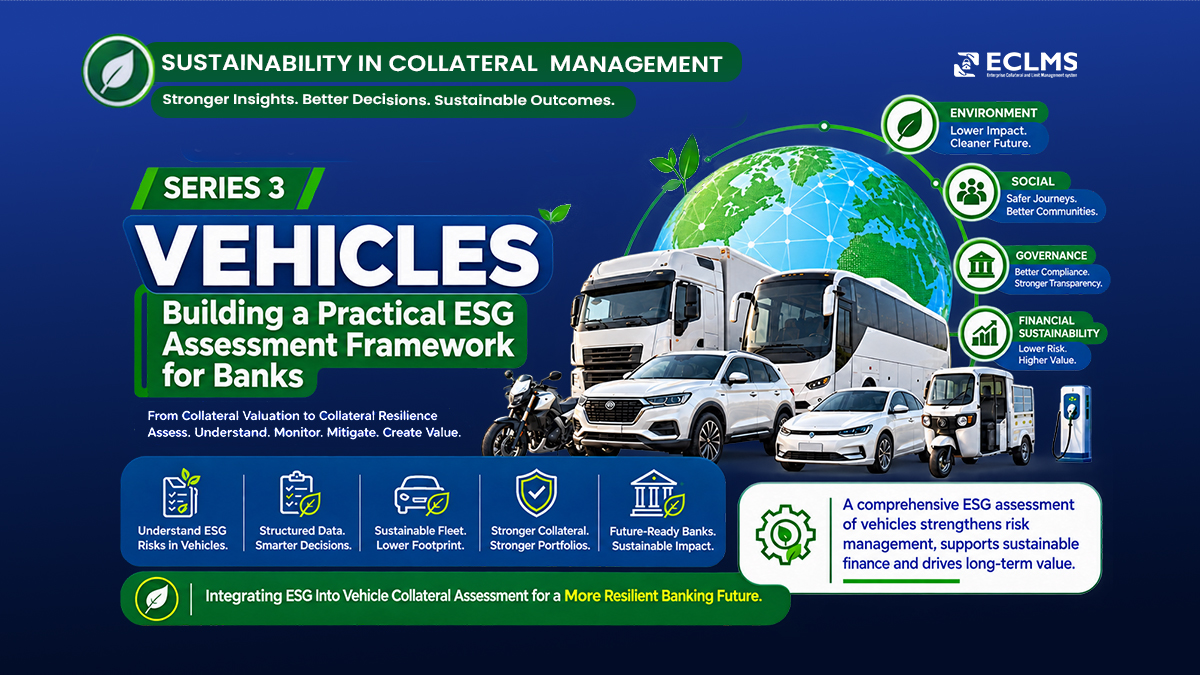
An overall snapshot summarises the proactive approach to vehicle finance vis a vis sustainable finance.

#CollateralManagement #VehicleFinance #ESG #Sustainability #Banking #ElectricVehicles #CommercialVehicles #GreenFinance #RiskManagement #ClimateRisk