
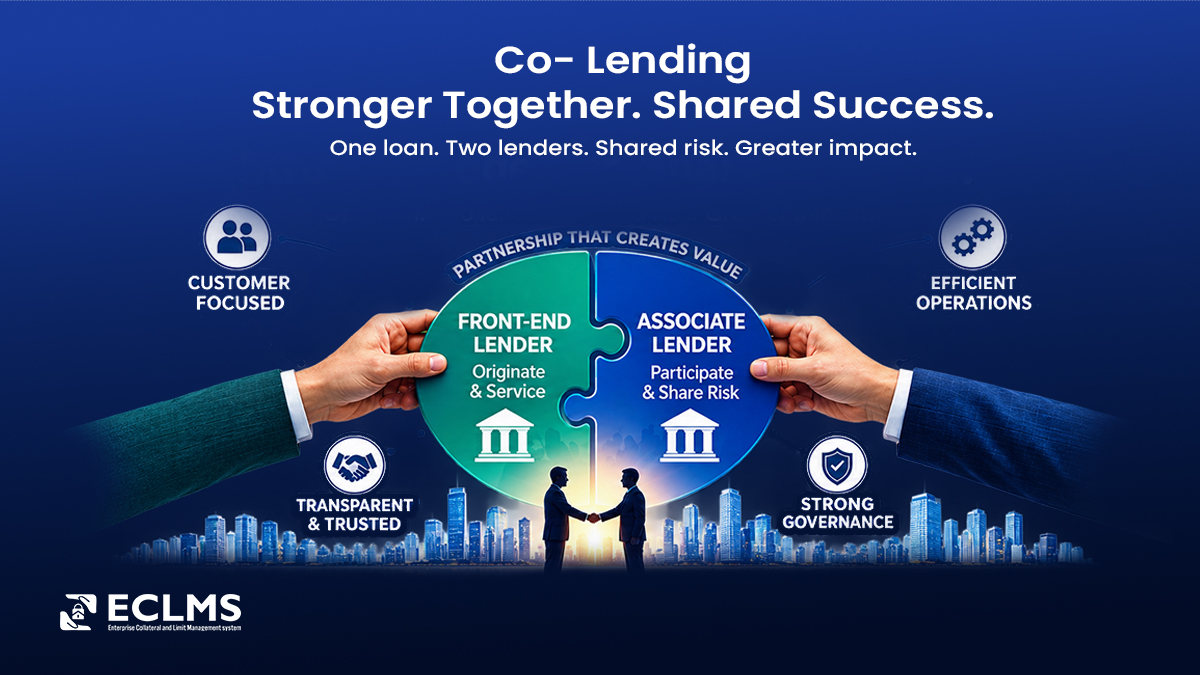
Co-lending is gradually becoming an important part of the lending landscape, particularly as banks and other regulated lenders look to combine their respective strengths in customer reach, origination, funding and risk participation.
At first glance, the concept appears simple.
Two lenders agree to finance a borrower. The loan is shared between them in an agreed proportion. Interest and other economic benefits are shared, and so is the credit risk.
But from a banker’s perspective, co-lending is much more than simply dividing a loan between two lenders.
The moment two lending institutions participate in the same credit exposure, the traditional lending lifecycle changes significantly.
A conventional loan largely follows a linear relationship:
Bank → Borrower → Disbursement → Repayment → Closure
A co-lending relationship is different.
There is still one borrower and one underlying credit requirement, but behind the loan there are two participating lenders, separate financial exposures, agreed responsibilities, shared cash flows and a continuing requirement to keep both lenders aligned throughout the life of the facility.
Understanding this lifecycle is important for bankers who will increasingly deal with such portfolios.

It Starts Before the Borrower Arrives
In conventional lending, the relationship effectively starts when the borrower approaches the bank.
In co-lending, an important relationship already exists before that happens — the relationship between the participating lenders.
The lenders first need to agree on the broad framework within which loans will be originated and shared.
They need to decide what type of borrowers and products will be covered, which lender will originate the loans, how the credit exposure will be shared, who will interact with customers, who will service the loans and how collections, income, defaults and recoveries will be dealt with.
This arrangement becomes the foundation for every loan subsequently originated under the program.
This is the first important distinction:
A co-lending loan operates within two relationships — the lender-to-lender relationship and the lender-to-borrower relationship.
Both must remain aligned throughout the loan lifecycle.
Who Faces the Customer?
Normally, one lender takes the lead in originating the customer relationship.
It may source the borrower, collect the application, undertake KYC and due diligence, evaluate the proposal, arrange documentation and remain the principal point of contact for the borrower.
The partner lender may not have the same level of day-to-day interaction with the customer, but it nevertheless has a real financial exposure to the borrower.
This creates an interesting operating model.
From the customer’s perspective, the experience should remain reasonably seamless.
Behind the scenes, however, both lenders need sufficient information to understand and monitor their respective exposure.
The customer-facing lender therefore does more than originate a loan. It becomes an important information and servicing bridge between the borrower and the participating lender.
Credit Assessment Remains Important to Both Lenders
The originating lender may undertake the detailed credit assessment, but participation in a loan cannot simply be treated as the purchase of a percentage of an unidentified pool.
The partner lender needs to know what it is participating in.
Depending upon the agreed arrangement, the partner may rely upon predefined eligibility and underwriting parameters or undertake additional assessment before taking its share.
This creates two related but distinct decisions:
Should this borrower be given the loan?
and
Should the partner lender participate in this particular exposure?
For bankers, this distinction becomes important because origination and participation are not necessarily the same credit decision.
One Loan — But Two Financial Exposures
Suppose a borrower receives a loan of ₹1 crore.
Under the agreed co-lending arrangement:
Lender A participates for 20% — ₹20 lakh
Lender B participates for 80% — ₹80 lakh
The borrower sees a ₹1 crore loan.
But each lender sees only its respective financial exposure.
This distinction must remain intact throughout the life of the loan.
If the borrower subsequently repays ₹10 lakh of principal, the overall outstanding may become ₹90 lakh, but the corresponding lender-level positions must also change.
The same principle applies to interest, overdue amounts, prepayments, write-offs and recoveries.
Co-lending therefore requires bankers to think about a loan simultaneously at two levels:
What does the borrower owe?
and
What is each lender’s economic interest in that amount?
Disbursement Is No Longer a Single-Lender Event
In conventional lending, the bank sanctions the facility and disburses the amount.
Under co-lending, funding itself becomes a coordinated activity.
Each lender has to contribute its agreed share, and the borrower ultimately needs to receive the intended disbursement.
Consider a ₹1 crore disbursement under an 80:20 arrangement.
One lender must ultimately fund ₹80 lakh and the other ₹20 lakh.
If one lender’s contribution is delayed, short-funded or incorrectly accounted for, the issue is no longer merely an internal reconciliation problem. It can potentially affect the borrower experience and the financial positions of both lenders.
The lenders therefore need visibility over:
What was supposed to be funded? What was actually funded? When was it funded? What was disbursed to the borrower?
Pricing Introduces Another Dimension
Pricing under co-lending can also be different from conventional lending.
The participating lenders may have different expected returns on their respective portions of the exposure. At the same time, the borrower needs clarity regarding the effective interest rate applicable to the loan.
This introduces the concept of a blended interest rate.
If 20% of a loan carries one lender’s economic rate and the remaining 80% carries another, the overall borrower pricing needs to appropriately reflect the agreed structure.
There is another commercial aspect that should not be confused with interest.
The customer-facing lender may perform sourcing, documentation, servicing, collection and other operational activities on behalf of the arrangement. Compensation for such activities may therefore form part of the commercial understanding between the lenders.
From a banker’s perspective, it is useful to distinguish:
return for assuming credit exposure
from
compensation for performing services.
The Real Operational Challenge Begins After Disbursement
Sanction and disbursement receive considerable attention in lending projects.
In my view, however, the more interesting challenge in co-lending begins after the money has been disbursed.
The borrower starts paying instalments.
Suppose an EMI of ₹1 lakh is received.
That ₹1 lakh is not simply an amount to be divided 80:20.
It may contain principal, normal interest, overdue interest, charges or other amounts.
Each component first needs to be appropriately recognised against the borrower’s obligation.
Only thereafter can the economic entitlement of the participating lenders be determined.
This creates an important distinction:
Collection from the borrower is one event. Distribution of that collection between lenders is another.
The two should not be confused.
Collection Distribution Becomes the Heart of the Operating Model
Consider a borrower payment of ₹1 lakh comprising:
Principal — ₹60,000 Interest — ₹38,000 Other charges — ₹2,000
Principal may broadly follow the lenders’ participation ratio.
Interest distribution may reflect their respective economic entitlement.
Some charges may belong to the servicing lender, while others may need to be treated differently under the agreement.
Therefore, blindly applying an 80:20 ratio to every rupee collected may not produce the correct result.
Every collection needs to answer three questions:
What has the borrower paid?
Against which obligation has it been appropriated?
How much belongs to each participating lender?
This is where a well-managed co-lending operation distinguishes itself from a simple loan-sharing arrangement.
And Then Comes Reconciliation
Once collections start moving, another banking discipline becomes critical — reconciliation.
The customer-facing lender may maintain the servicing position.
Each participating lender maintains its own financial exposure.
Collections move through the agreed banking arrangements.
Accounting entries are passed independently by the participating institutions.
All these positions must ultimately agree.
If the borrower has paid ₹5 lakh, one lender cannot recognise a reduction while the other continues to show the old exposure.
Similarly, differences in principal, accrued interest, overdue amounts or collections cannot remain unresolved indefinitely.
Co-lending therefore creates a continuing requirement for reconciliation rather than merely a month-end accounting exercise.
What Happens When the Borrower Does Not Pay?
This is where co-lending becomes even more interesting from a risk-management perspective.
Suppose an instalment becomes overdue.
Which lender identifies the default?
Who communicates it to the other lender?
How quickly?
What Days Past Due should each lender recognise?
What happens when the account moves into SMA or NPA classification?
A shared credit exposure cannot be effectively managed if one participating lender considers the account regular while the other considers the same underlying co-lending exposure stressed.
Timely exchange of delinquency and asset-classification information therefore becomes an essential part of the relationship.
In other words, co-lending requires not only financial synchronisation, but also risk synchronisation.
Recovery Raises a Different Set of Questions
When an account becomes seriously stressed, another practical issue arises.
Who pursues the borrower?
It would make little operational sense for two lenders to independently call the same borrower, issue conflicting instructions or initiate uncoordinated recovery action.
The co-lending arrangement therefore needs clarity regarding who leads collections and recovery.
But leading the recovery does not mean owning the entire decision.
Important decisions may require consultation or consent between lenders — restructuring, settlement, legal proceedings, enforcement of security, waiver, write-off or compromise.
The operating principle should therefore be clear:
One lender may lead the recovery process, but the economic interests and agreed decision rights of both lenders must be protected.
Recoveries Must Again Be Distributed
Suppose a stressed loan with ₹50 lakh outstanding ultimately produces a recovery of ₹30 lakh.
The question is not merely whether ₹30 lakh has been recovered.
Bankers must also determine:
What portion represents principal?
What portion represents interest?
Were recovery or legal expenses incurred?
How should those expenses be borne?
What amount belongs to each lender?
Does the recovery follow the original participation ratio, or are there other contractual considerations?
Once again, the same basic co-lending principle emerges:
A borrower-level transaction ultimately has to be translated into lender-level financial positions.
Collateral Cannot Be Forgotten
For secured loans, co-lending introduces another important dimension.
There may be one property, vehicle, plant or other security supporting a loan in which two lenders have economic interests.
The security therefore needs to be understood in the context of the overall exposure as well as the respective lender positions.
Bankers need continuing visibility over valuation, insurance, creation and perfection of charge, enforceability and eventual release of security.
The position becomes even more important during recovery.
Who initiates enforcement?
Who controls the security documents?
How are enforcement expenses shared?
How are sale proceeds distributed?
Collateral governance in co-lending therefore cannot be separated from exposure governance.
Even Loan Closure Requires Coordination
In conventional lending, when all dues are recovered, the account can normally proceed towards closure and release of security.
Under co-lending, one additional question needs to be answered:
Have both lenders been completely settled?
A borrower may have paid everything due, but there may still be an unsettled amount between the participating lenders.
Therefore, a co-lending relationship should ideally reach closure only when:
the borrower’s obligation is fully settled;
both lender exposures have been extinguished;
all collections have been distributed;
inter-lender settlements are complete;
reconciliation differences have been resolved; and
the security can be appropriately released.
Only then has the complete economic lifecycle ended.
Co-Lending Is Ultimately About Maintaining Multiple Views of the Same Loan
From a banker’s perspective, perhaps the simplest way to understand co-lending is through four questions that need to be answered throughout the life of every loan:
1. Borrower Position — What does the borrower owe?
2. Lender Position — How much of that exposure belongs to each lender?
3. Cash-Flow Position — What has been received and how has it been distributed?
4. Risk Position — How is the underlying exposure performing and classified?
If these four positions remain aligned, co-lending can operate smoothly.
If they begin to diverge, operational, accounting, customer-service and regulatory issues can quickly emerge.
From Loan Sharing to Lifecycle Management
Co-lending should therefore not be viewed simply as:
“Bank A funds 20% and Bank B funds 80%.”
That is only the starting point.
The co-lending model is illustrated hereunder:

As co-lending portfolios grow, the challenge for banks will increasingly shift from entering into co-lending arrangements to managing them efficiently throughout their lifecycle.
The institutions that do this well will need clear allocation of responsibilities, disciplined information sharing, transparent lender-wise exposure tracking, robust collection distribution, synchronised risk monitoring and strong reconciliation.
The borrower may experience one loan.
But behind that loan are two balance sheets, two risk positions and a continuing financial relationship between the participating lenders.