
0

Collaterals in the New ECL-Based IRAC Framework

the Importance of Collateral Management Has Increased in the RBI’s Evolving Credit Risk Architecture
Why the Importance of Collateral Management Has Increased in the RBI’s Evolving Credit Risk Architecture 

1. Introduction

The transition of the Indian banking sector from the traditional prudential Income Recognition and Asset Classification (IRAC) framework to the Expected Credit Loss (ECL)-based impairment regime represents one of the most significant transformations in credit risk management in recent decades. The revised framework introduced by the Reserve Bank of India fundamentally changes the manner in which banks recognize stress, estimate losses, classify assets, and maintain provisions against credit exposures.

Much of the industry discourse around the new framework has focused on:

  • Probability of Default (PD),
  • Loss Given Default (LGD),
  • Exposure at Default (EAD),
  • staging methodology,
  • macroeconomic overlays,
  • and forward-looking provisioning models.

However, amidst these discussions, a critical misconception has started emerging across banking and technology circles — the assumption that collateral management may lose significance in the new ECL-based IRAC environment because traditional “security erosion” rules may no longer remain central to asset classification.

This perception is fundamentally incorrect.

In reality, the ECL framework significantly increases the strategic importance of collateral management. What changes is not the relevance of collateral, but the manner in which collateral influences risk assessment and provisioning.

Under the legacy IRAC architecture, collateral was largely viewed as a prudential support mechanism. Under the ECL regime, collateral becomes a core risk parameter driving expected recoverability and loss estimation.

This transformation requires banks to completely rethink the design, governance, valuation, monitoring, and technological integration of collateral management systems.

The future banking environment will no longer permit collateral systems to function merely as operational repositories maintaining charge records and valuation dates. Instead, collateral management must evolve into an intelligent, continuously monitored, analytically driven risk management ecosystem integrated deeply with enterprise credit risk architecture.

The institutions that fail to recognize this transformation may face serious challenges in:

  • ECL accuracy,
  • provisioning adequacy,
  • model validation,
  • supervisory assessments,
  • and portfolio risk visibility.

Conversely, banks that redesign collateral management as an enterprise risk intelligence capability will gain substantial advantages in:

  • credit monitoring,
  • early warning detection,
  • capital optimization,
  • recovery estimation,
  • and risk-adjusted profitability.

2. Traditional Role of Collateral Under Existing IRAC Norms

To understand the transformation underway, it is important first to understand the traditional role collateral played under the existing IRAC framework.

Historically, the prudential framework in India followed a largely rule-based approach toward asset classification and provisioning. Asset quality deterioration was primarily recognized based on:

  • Days Past Due (DPD),
  • default events,
  • restructuring events,
  • prudential supervisory triggers,
  • and specified regulatory conditions.

Within this architecture, collateral primarily served four broad purposes:

A. Credit Risk Mitigation

Collateral provided secondary repayment support in case borrower cash flows failed.

B. Prudential Provisioning Support

Availability of security enabled differentiated provisioning treatment between secured and unsecured portions of exposures.

C. Regulatory Asset Classification Triggers

Specific prudential rules such as “security erosion” could directly impact asset classification.

D. Recovery Support

Collateral acted as a legal enforcement and recovery mechanism after default.

Among these, the “security erosion” concept became one of the most prominent regulatory mechanisms influencing collateral management practices.

Under traditional IRAC guidelines:

  • where the realizable value of security declined below specified thresholds,
  • banks were required to accelerate asset classification deterioration irrespective of repayment conduct.

For example:

  • if the realizable value of security fell below 50% of assessed value, the account could be straightaway classified as doubtful,
  • if realizable value fell below 10% of outstanding, the exposure could be identified as a loss asset.

This framework resulted in collateral systems being designed primarily as compliance-oriented utilities.

Accordingly, most banking collateral management systems focused on:

  • periodic valuation tracking,
  • security coverage computation,
  • document management,
  • charge registration,
  • margin monitoring,
  • and prudential reporting.

The operational question under the old regime was relatively straightforward:

“Has the security erosion threshold been breached?”

If yes, the system triggered supervisory classification consequences.

The approach was therefore:

  • threshold-driven,
  • event-based,
  • and largely binary.

Collateral deterioration was treated as a regulatory event rather than a continuously evolving risk parameter.


3. The Conceptual Shift Introduced by the ECL Framework

The ECL framework fundamentally changes this philosophy.

The new model replaces the traditional “incurred loss” approach with a “forward-looking expected loss” methodology.

Under the incurred loss regime:

  • losses were generally recognized after observable deterioration or default events occurred.

Under ECL:

  • losses are estimated proactively based on future expected recoverability.

This shift is transformational.

The ECL methodology estimates expected losses using three core parameters:

  • Probability of Default (PD),
  • Loss Given Default (LGD),
  • Exposure at Default (EAD).

Among these, collateral has a direct and material influence on LGD.

LGD essentially estimates the economic loss likely to arise if default occurs after considering expected recoveries.

This means collateral now directly affects:

  • expected recovery values,
  • recovery timelines,
  • distress realization estimates,
  • legal recovery costs,
  • and economic recoverability assumptions.

Consequently, collateral becomes embedded within the core mathematics of provisioning itself.

Under the new framework, deterioration in collateral value no longer needs a separate prudential “trigger” to influence provisioning.

Instead:

  • every change in collateral quality dynamically influences expected losses.

This is the most important conceptual transition.

Under old IRAC:

security erosion was a classification event.

Under ECL:

collateral deterioration becomes a continuously evolving risk variable.

This distinction fundamentally changes the design philosophy of collateral management systems.


4. Why Security Erosion Does Not Become Redundant

The emergence of ECL has led some industry participants to assume that since specific “security erosion” downgrade rules may reduce in prominence, collateral management itself may become less important.

This assumption is dangerous and misleading.

The reality is exactly the opposite.

The ECL framework makes collateral management significantly more important because collateral now directly impacts provisioning accuracy.

In the traditional framework:

  • security erosion mattered only after certain thresholds were breached.

Under ECL:

  • every deterioration in collateral quality matters.

For example:

  • decline in property prices,
  • inventory obsolescence,
  • stock market volatility,
  • deterioration in receivable quality,
  • legal disputes,
  • insurance lapses,
  • enforceability challenges,
  • or delays in recovery realization

can all impact expected recoverable value.

These changes directly affect LGD estimation and therefore ECL provisioning.

The provisioning effect therefore becomes:

  • continuous,
  • dynamic,
  • and economically sensitive.

Thus, while simplistic threshold-based “security erosion” rules may gradually lose independent significance, collateral itself becomes far more deeply integrated into the risk measurement process.


5. Collateral as a Core Input in LGD Estimation

The most critical role of collateral in the ECL framework lies in LGD computation.

Loss Given Default represents the proportion of exposure expected to remain unrecovered after default.

Conceptually:

[
LGD = \frac{Exposure – Expected\ Recovery}{Exposure}
]

Expected recovery is heavily dependent upon:

  • collateral quality,
  • realizable value,
  • enforceability,
  • and liquidation efficiency.

Accordingly, collateral management becomes central to:

  • provisioning estimation,
  • model calibration,
  • and portfolio stress assessment.

Unlike traditional provisioning norms, ECL requires banks to estimate:

  • future economic recoveries,
  • distress sale realizations,
  • time value of recovery cash flows,
  • legal recovery delays,
  • enforcement costs,
  • and market volatility.

This significantly elevates the sophistication required in collateral valuation methodologies.

Collateral valuation can no longer remain:

  • static,
  • periodic,
  • or purely compliance-oriented.

Instead, valuation must become:

  • dynamic,
  • risk-sensitive,
  • scenario-based,
  • and forward-looking.

6. Importance of Objective Collateral Valuation

One of the biggest implications of the ECL framework is the increasing need for objective collateral valuation systems.

Historically, many collateral valuations in the banking system relied heavily on:

  • periodic appraisals,
  • standardized haircuts,
  • conservative approximations,
  • and manual assessments.

Such approaches may prove inadequate under ECL.

The new framework requires collateral values to reflect:

  • realistic realizable value,
  • stressed market conditions,
  • liquidity risk,
  • volatility risk,
  • and enforceability uncertainty.

For example:

  • a commercial property in an oversupplied market cannot be valued merely at nominal market rates,
  • inventory financed under supply-chain arrangements may rapidly deteriorate in realizable value,
  • receivables may become impaired due to counterparty weakness,
  • machinery may have low secondary market demand,
  • project assets may suffer severe realization constraints.

Accordingly, collateral valuation systems must increasingly incorporate:

  • market intelligence,
  • distress liquidation modelling,
  • scenario analysis,
  • volatility indicators,
  • and sectoral sensitivity analysis.

This requires a major transformation in collateral governance architecture.


7. Dynamic Monitoring of Collateral

Another major change introduced by the ECL framework is the need for continuous collateral monitoring.

Under traditional systems:

  • collateral values were often reviewed annually or periodically.

Under ECL:

  • collateral quality must be continuously assessed because changes in collateral directly affect provisioning.

Future-ready collateral systems must therefore support:

  • automated revaluation triggers,
  • market-linked valuation updates,
  • volatility monitoring,
  • stress testing,
  • concentration analysis,
  • insurance tracking,
  • legal enforceability monitoring,
  • and exception alerts.

The system must identify:

  • sudden value deterioration,
  • stale valuations,
  • collateral concentration risks,
  • weakening enforceability,
  • and sector-specific vulnerabilities.

This transforms collateral management from a passive administrative function into an active risk surveillance mechanism.


8. Data Quality Becomes Critically Important

The ECL framework dramatically increases the importance of collateral data quality.

Under earlier IRAC systems, incomplete collateral information may still have allowed operations to continue because provisioning often depended primarily on regulatory classification categories.

Under ECL:

  • poor collateral data directly distorts LGD estimates,
  • which in turn affects provisioning accuracy.

Consequently, banks require stronger collateral data governance covering:

  • ownership details,
  • charge ranking,
  • enforceability status,
  • valuation history,
  • insurance validity,
  • legal disputes,
  • document deficiencies,
  • jurisdiction mapping,
  • cross-collateralization,
  • guarantor linkage,
  • and recovery experience.

Collateral systems must therefore evolve toward:

  • centralized data architecture,
  • standardized metadata frameworks,
  • integrated document repositories,
  • and enterprise-wide risk visibility.

9. Integration of Collateral Systems with ECL Engines

Perhaps the most important architectural implication of the ECL framework is the need for deep integration between collateral systems and enterprise risk engines.

Historically, collateral systems often operated independently from:

  • risk rating systems,
  • provisioning engines,
  • recovery systems,
  • and credit monitoring platforms.

Such silo-based architectures are unlikely to remain sustainable.

Under ECL, collateral systems must integrate with:

  • ECL computation engines,
  • staging models,
  • early warning systems,
  • limit management systems,
  • recovery platforms,
  • legal systems,
  • and enterprise risk management frameworks.

The future architecture requires collateral to function as a live risk parameter across the institution.


10. Role of Collateral in Stage Migration

Collateral deterioration also influences staging assessment under ECL.

Weakening collateral quality may indicate:

  • increased credit risk,
  • deterioration in borrower viability,
  • or declining recovery prospects.

Accordingly, collateral behaviour may influence:

  • Stage 1 to Stage 2 migration,
  • Stage 3 identification,
  • restructuring decisions,
  • and impairment assessments.

This significantly expands the influence of collateral beyond traditional provisioning support.


11. Supervisory Expectations in the New Regime

Although ECL introduces model-driven provisioning, regulators are unlikely to abandon prudential conservatism entirely.

Supervisory overlays may continue for:

  • unsecured exposures,
  • stale valuations,
  • legal deficiencies,
  • fraud accounts,
  • and stressed sectors.

Therefore, banks should not eliminate existing security erosion controls completely.

Instead, such controls should be redesigned as:

  • supervisory override mechanisms,
  • LGD adjustment triggers,
  • valuation reliability indicators,
  • and risk escalation parameters.

This hybrid approach will provide stronger resilience during the transition phase.


12. Future of Collateral Management

The ECL framework transforms collateral management from:

  • a compliance-oriented support function
    to
  • an enterprise risk intelligence discipline.

Future-ready collateral systems must support:

  • dynamic valuation,
  • predictive analytics,
  • stress testing,
  • recovery modelling,
  • market integration,
  • scenario analysis,
  • and real-time monitoring.

The future banking environment will increasingly require:

  • intelligent collateral ecosystems,
  • objective valuation frameworks,
  • integrated risk architecture,
  • and analytics-driven recoverability assessment.

Banks that continue to treat collateral as a static register of securities may face serious challenges in:

  • ECL accuracy,
  • provisioning adequacy,
  • audit validation,
  • and supervisory assessment.

Conversely, institutions investing in modern collateral intelligence platforms will gain significant advantages in:

  • portfolio risk visibility,
  • capital optimization,
  • recovery forecasting,
  • and proactive credit monitoring.

13. Conclusion

The evolution from traditional IRAC norms to the ECL-based framework does not diminish the importance of collateral management.

It magnifies it.

The earlier prudential architecture viewed collateral primarily as protection after default.

The ECL framework views collateral as a continuously evolving determinant of expected loss.

This is the real transformation.

The disappearance of simplistic “security erosion” thresholds should not be interpreted as reduced relevance of collateral.

Rather, it marks the end of superficial collateral management practices.

The future belongs to:

  • objective valuation methodologies,
  • dynamic recoverability assessment,
  • integrated risk analytics,
  • and intelligent collateral governance frameworks.

In the emerging ECL environment, the central question is no longer:
“Does the bank hold security?”

The real question is:
“How accurately can the bank estimate the realisable economic value of collateral under stressed recovery conditions?”

The answer to this question will increasingly determine:

  • provisioning adequacy,
  • portfolio resilience,
  • capital strength,
  • and the overall quality of credit risk governance within banks.

The new ECL era, therefore, demands not weaker collateral management but stronger, smarter, and significantly more scientific collateral management systems.


Integrating Limit Management with Core Bankng and Treasury Systems 

Integrating Limit Management with Core Banking

Every bank operates on trust — and that trust is only as strong as its ability to know, at any given moment, how much exposure it carries across counterparties, products, and geographies. Yet many financial institutions, credit and exposure limits are managed in isolation: a treasury system here, a core banking platform there, and a patchwork of spreadsheets holding it all together. 

This fragmentation is no longer a nuisance. It is a risk. 

  • 67% of banks report limit data is siloed across 3+ systems 
     
  • 4–8 hr saverage delay in breach detection with end-of-day monitoring 
     
  •  higher operational cost when limits are managed manually 
     

Why integration is the executive priority, not the IT priority 
 

It is tempting to frame system integration as a technology project — something delegated and revisited at a quarterly review. But the consequences of fragmented limit management surface directly on the balance sheet, in regulatory examinations, and in the boardroom after a breach. 

When your core banking system processes a transaction without querying live limit data from your treasury system, you are not running two separate platforms. You are flying blind on one of your most critical risk controls. 

“Real-time limit visibility is not a nice-to-have feature. It is the difference between catching an exposure breach in seconds and discovering it in the morning report.” 

The three integration failure points executives must know 

1. Data latency 

Most legacy architectures rely on batch processing — limits are reconciled at end-of-day or even end-of-week. In fast-moving markets, a counterparty’s exposure can breach limits multiple times within a single trading session before anyone is notified. By the time the report lands, the damage is done. 

2. Siloed approval workflows 

When limit changes require sign-off across treasury, credit, and operations, but each team works from a different system with no shared record, approvals slow to a crawl. More dangerously, temporary overrides granted in one system may never be registered in another — creating phantom headroom that doesn’t exist. 

3. Incomplete counterparty view 

A counterparty that appears within limits in the core banking system may have significant exposure sitting in the derivatives book, the trade finance module, or an off-balance-sheet facility. Without a consolidated view, no single number tells the truth about total exposure. 

What genuine integration looks like 

A modern, integrated limit management architecture connects real-time transaction data from core banking, live market positions from treasury, and limit governance workflows into a single, authoritative control layer. Changes to limits propagate instantly. Breaches trigger alerts before — not after — settlement. And every decision leaves an auditable trail across systems. 

The capabilities that matter most at the executive level: 

  • Real-time limit utilisation visible across all business lines simultaneously. 
  • Automated breach alerts routed to the right approver without manual escalation. 
  • A single limit hierarchy that core banking and treasury systems query from one source of truth. 
  • Full audit log of limit changes, exceptions, and approvals — regulator-ready at any point. 
  • API-based connectivity that integrates without replacing existing core systems. 

Enterprise Credit Limit Management System (ECLMS) 

ECLMS is purpose-built for financial institutions that need unified limit management system without ripping out their existing infrastructure. It connects via secure APIs to your core banking platform and treasury systems, delivering a real-time, consolidated limit control layer — with configurable workflows, breach escalation, and regulatory reporting built in from day one. 

Banks using ECLMS have reduced limit breach response time from hours to minutes, eliminated manual reconciliation between systems, and walked into regulatory audits with complete, timestamped audit trails — without any last-minute scramble. 

Learn more about ECLMS ↗ 

Build, buy, or integrate? 

Most institutions do not need to replace their core banking system to solve this problem. What they need is a dedicated limit management layer that acts as the single source of truth — connecting upward to the board dashboard and downward to every system that touches a limit-sensitive transaction. 

The right question is not “can our current systems be patched to do this?” — most can, to a degree. The right question is: “can we afford the next breach, the next regulatory finding, or the next quarter of manual reconciliation while we wait for a patch?” 

Integration is achievable in weeks, not years, when the architecture is designed for it from the start. 

Final Words  

The institutions winning on risk management in 2026 are not those with the most sophisticated models. They are the ones where the right limit data reaches the right person in real time — automatically, reliably, and with full accountability. Integration is what makes that possible. 

If your limit management still depends on overnight batch runs, manual overrides, or spreadsheet reconciliations between systems, this is not a technology debt issue. It is a strategic risk issue — and it belongs to the agenda today. 

0

The “Liquidity Trap” of 2026 – Moving from Static to Real-Time Collateral 

For decades, the term “Liquidity Trap” belonged to the world of macroeconomics—a scenario where rock-bottom interest rates fail to stimulate growth because everyone is hoarding cash. But as we move through 2026, a new, more technical version of this trap has emerged within the plumbing of global finance. 

As institutional demand for intraday liquidity skyrockets, the industry is reaching a tipping point. The transition from static to real-time collateral management is no longer a “nice-to-have” digital transformation project; it is a survival requirement. By leveraging tokenization, programmable smart contracts, and unified API ledgers, the financial world is finally learning how to melt these frozen pools of capital. 

The 2026 Dilemma: Why the “Trap” is Structural 

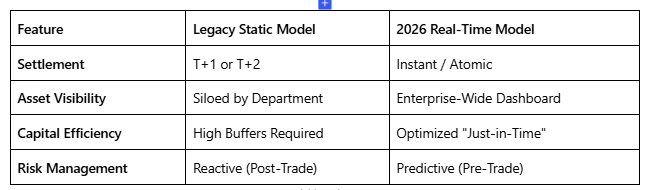
Historically, a liquidity trap was defined by consumers hoarding cash. In 2026, the trap is operational. Our financial ecosystem is moving toward T+0 settlement and real-time payments (via UPI and CBDC-W), yet our collateral remains locked in legacy, “static” silos. 

  • The “Idle Asset” Tax: Thousands of crores in high-quality liquid assets (HQLA) sit idle because valuation and movement happen in batches, not beats. 
  • The LCR Squeeze: New RBI regulations effective April 1, 2026, mandate stricter haircuts on Level 1 HQLA. This means banks must work their assets harder just to maintain the same Liquidity Coverage Ratio (LCR). 
  • Operational Friction: In a volatile market, the time lag between a margin call and the mobilization of collateral is no longer just an inefficiency—it’s a systemic risk. 

The Pivot: From Static to Real-Time Collateral 

To break the trap, we must shift the institutional mindset. Collateral should no longer be viewed as a “back-office safety net” but as a strategic liquidity engine. 

1. Tokenization of Real-World Assets (RWAs) 

The RBI’s Unified Markets Interface (UMI) has paved the way. By tokenizing Government Securities (G-Secs) and even corporate debt, banks can move “fractions” of collateral instantly. 

Strategic Edge: Tokenized collateral allows for intraday liquidity—allowing you to borrow for three hours rather than twenty-four, significantly lowering funding costs. 

2. AI-Driven Inventory Optimization 

With “Agentic AI” moving from pilot to production in 2026, banks are now using autonomous agents to scan global and domestic inventory in real-time. These systems automatically select the “cheapest to deliver” asset for any given margin requirement. 

3. Real-Time Valuation & Margin Calls 

Static daily marks are being replaced by streaming valuations. For NBFCs and private banks, this means the ability to release collateral the moment market moves in their favor, rather than waiting for the end-of-day (EOD) cycle. 

The Competitive Advantage for Indian Banks 

India is uniquely positioned to lead this shift. With the Digital Rupee (Wholesale CBDC) maturing, the “atomic settlement” of collateral—where the asset and the payment swap simultaneously—is now a reality. 
The Mandate  

 We must collaborate to: 

  • Dismantle Silos: Consolidate collateral held across derivatives, repo, and SLR desks. 
  • Invest in API-First Infrastructure: Ensure your core banking system can “talk” to external tokenization platforms and the RBI’s UMI. 
  • Re-evaluate Haircuts: Use real-time data to negotiate better terms with counterparties, proving the high quality and mobility of your digital assets. 

 
Escaping the Trap: The Strategic Path Forward 

The 2026 Reality: In a high-speed market, the most asset isn’t just the one with the highest rating—it’s the one that is most mobile. 

This is where ECLMS becomes the mission-critical infrastructure for the modern bank. By providing a single source of truth for all customer credit data and real-time exposure tracking, ECLMS doesn’t just manage collateral—it unlocks it. It automates the entire lifecycle from onboarding to revaluation and release, ensuring that your capital is never “trapped,” but always optimized.  
6

Collateral Management -An Approach to Automation – Part-1

Friends, we are starting this multi-part series to cover collateral management from a lender’s perspective and scenarios important for automating Collateral Life Cycle Management. We trust that the contents of this series will ignite thought process in the community which is predominantly manual as on date

Collaterals are the first and most important credit risk mitigate available to a lender, however, collateral management is predominantly a manual process. Considering the proliferation of digitization and automation in the financial industry, collateral management automation is still not a priority area. Our objective of this series is to bring forth the critical aspects of the collateral management process and considerations for automation of life cycle management of collaterals from a lender’s perspective.

While sanctioning a secured loan, the lenders secure collaterals under their charge using different methodologies depending on the type of collateral being created out of the lender’s funds or offered by the customer. Accordingly, the collaterals may be broadly categorized into two categories: Primary Collaterals: The asset which is created out of the funds is considered as primary collateral. Say loans given to purchase vehicles, plant and machinery etc will create assets as vehicle/ plant & machinery that will be hypothecated to the bank but will remain under the procession of the borrower. In this case, the asset created out of funds of the lender will used for use by the borrower.

Secondary Collaterals: many times lenders resort to securing their funds by taking additional collaterals which are in most cases Immovable Property. Such additional collateral is termed Secondary collaterals. Secondary collaterals serve as additional collateral coverage to the exposure of the lender and primarily the title and/ or the asset will remain in possession of the lender.

However, such categorization may become blurred in many cases like loans against customer’s FDR, Shares, NSC, KVP, Gold etc. are often considered as primary collaterals in banking parlance whereas in actual sense these are secondary collateral, since the funds given by the lender are going to be utilized by the customer for either creation of other assets or purely for expanses.

For creating a charge on the collateral offered/created needs to undergo different perfection events depending on the type of collateral, once the collateral is perfected it is available for onboarding and tagging at various levels of the limit hierarchy of the customer. Based on the tagging of the collateral at the respective limit hierarchy level, the value of the collateral is distributed among various facilities of the customer.

Post onboarding of the collateral, two important aspects need to be performed, firstly, if there is any deviation in the pre-onboarding perfection process that should be complied with at the earliest and post onboarding activities like post disbursement inspection and registration of charge with competent authority also need to be performed. The charge on the collateral is registered with the respective authority depending on the type of collateral.

Subsequently, regular maintenance like insurance, re-valuation and re-inspection are the activities that need to be carried out by the lender for upkeeping of the collateral good and realizable till the existence of the tagged exposure so that delinquency risk is mitigated.

Finally, once the loan is repaid by the customer, the collateral needs to be released (release of title documents on which the charge was created) to the customer upon due acknowledgement.

In the Next Part – Various Types of Collaterals

Author: VC Sharma

Disclaimer: The views expressed in the blog are entirely personal to the author. There is no direct/ indirect responsibility of the publisher whatsoever.

0

Technology and Digital Transformation in Collateral and Limit Management 

Ever thought about what goes on behind the scenes when banks give out loans? Especially when they ask for something as security – you know, collateral? For the longest time, this whole process in Indian banks was, well, a bit of a manual marathon. Think mountains of spreadsheets and rooms full of physical documents.  
 
But guess what? Things are finally changing, and it’s all thanks to digital transformation
 
The Good Old Days (and Their Headaches!) 

Let’s be real, managing collateral used to be a proper headache. If you pictured a bank’s back office, you might’ve seen: 

  • Spreadsheet Mania: Imagine giant, sprawling spreadsheets trying to keep tabs on everything from your granddad’s property deeds to that gold you pledged. One wrong click, and poof! Data chaos. Keeping everything accurate was a nightmare. 
     
  • Paper, Paper Everywhere: Bank vaults weren’t just for cash; they were bursting with original property papers, share certificates, and all sorts of important documents. Getting them out, checking them, and moving them around for every transaction was a slow, security-heavy dance. 
     
  • Playing Catch-Up: How much is that collateral really worth today? With manual updates, valuations were often outdated. This meant banks were often a step behind when managing risks or figuring out real values. Reconciling everything was like solving a giant, never-ending puzzle. 
     
  • Blind Spots: Want a quick overview of all the collateral a bank holds? Good luck! It took ages to pull all that info together. This made it tough to get a clear picture of risks or assets in real-time. 
     
  • Regulation Riddles: India has some pretty strict rules from the RBI. Trying to follow all those guidelines with manual processes was a constant tightrope walk, often leading to mistakes and inefficiencies. 

Honestly, this old way of doing things just couldn’t keep up with how fast Indian banking is growing. It wasted time, piled on risks, and frankly, slowed down the whole lending process. 

Hello, Digital Age! 

But here’s the exciting part: Indian banks are now fully embracing digital transformation for their collateral management. It’s not just about fancy software; it’s about fundamentally changing how they view, track, value, and use collateral. 

So, what’s cooking? 

  1. Everything in One Place: Banks are moving to smart, integrated collateral management systems (CMS). Think of it as a central hub where all collateral data lives digitally – no more hunting through separate spreadsheets! 
     
  1. Real-Time Values, No More Guesswork: These new systems can connect to live market data. So, whether it’s property prices or share values, banks get near real-time updates. This helps them stay on top of things, make quicker decisions, and manage potential risks way better. 
     
  1. Bye-Bye Paper, Hello Digital Workflow: Those physical documents? Many are getting digitized and stored securely, directly linked to your loan accounts. And the processes for creating, releasing, or swapping collateral are now automated. Less human error, more speed! 
     
  1. Smart Insights and Reports: With all that clean, digital data, banks can now use powerful analytics. They can quickly spot potential risks, understand where their collateral is concentrated, and generate all sorts of compliance reports with just a few clicks. It’s like having a superpower for decision-making! 
     
  1. Talking to Each Other: These modern CMS solutions aren’t islands. They seamlessly connect with a bank’s other systems – like the ones that handle your main bank account or process new loan applications. This means information flows smoothly, making everything more accurate and efficient from start to finish. 
     
  1. Techy Tricks Up Their Sleeves: 
  1. AI and Machine Learning: Think smart computers predicting collateral value changes or flagging anything unusual. 
  1. Blockchain: This is still a bit new, but imagine completely transparent and secure records of who owns what collateral – super cool for reducing fraud! 
  1. Digital Public Infrastructure (DPI): Concepts like the Account Aggregator are letting banks get digital consent to view your financial data, making it even easier and faster to assess collateral. 

Why This is Great News for Everyone 

Going digital with collateral management isn’t just a win for banks; it’s a win for all of us! 

  • Faster, Smoother Loans: Banks can process loans quicker, which means you get your funds faster. 
  • Better Risk Management: Less risk for banks means a more stable financial system overall. 
  • Happier Customers: Efficient processes lead to a smoother, less frustrating experience for borrowers. 
  • Smarter Decisions: Banks can make more informed choices about lending, benefiting both them and the economy. 
  • Less Paperwork (Yay!): Good for the environment, good for bank offices! 


Ready to Modernize Your Collateral Management? 

As you can see, the shift from traditional to digital collateral management isn’t just a trend; it’s a necessity for Indian banks aiming to stay competitive and secure. 

If your bank is looking to shed those old spreadsheets and embrace a truly efficient, risk-smart, and future-ready approach, then it’s time to explore ECLMS: Enterprise Collateral and Limit Management System. 

ECLMS isn’t just software; it’s a comprehensive solution designed specifically to tackle the complexities of collateral and limit management in the Indian banking landscape. It helps banks: 

  • Automate the entire collateral lifecycle: From initial onboarding and valuation to monitoring, release, and disposal. 
     
  • Get a 360-degree view: Consolidate all collateral and limit data for a holistic picture across your entire enterprise. 
  • Proactively manage risk: With real-time exposure tracking and automated alerts for limit breaches and collateral value changes. 
     
  • Ensure seamless compliance: Stay effortlessly aligned with RBI regulations and internal policies. 
     
  • Optimize capital and resources: By efficiently allocating collateral and preventing over or under-utilization. 

ECLMS empowers banks to transform their credit risk management, enhance operational efficiency, and accelerate their lending processes. It’s the strategic advantage you need to thrive in today’s dynamic financial environment. 

Curious to learn more about how ECLMS can revolutionize your bank’s collateral and limit management?  
 
Reach out to us today for a demo!